








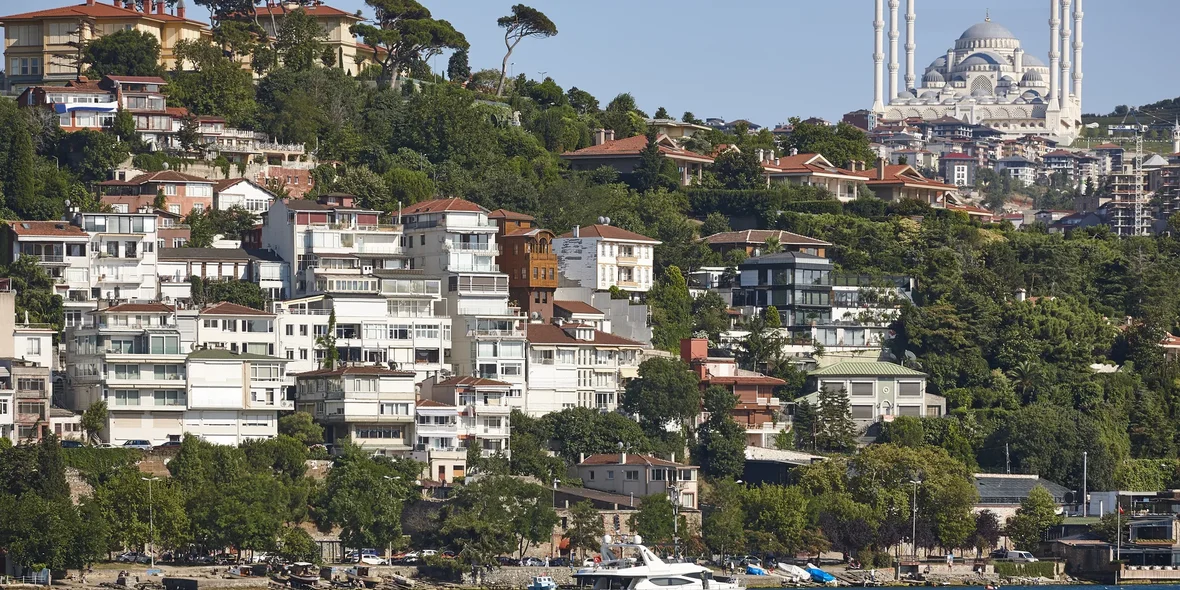
“Turkey Is No Longer the Same?”: Honest Analysis of the Real Estate Market in 2026


The Turkish real estate market in 2026 looks less and less like a market of quick resales at the foundation pit stage and more and more like a market for investors with medium and above-average capital who are ready to work under tightened rules and look at a horizon of 5+ years.
Nominal prices in Turkish lira continue to grow amid high inflation and rising construction costs. In currency terms (USD/EUR), the situation is much calmer: in a number of regions there is a price plateau, and in certain segments — stagnation relative to the peaks of 2022–early 2023.
Price dynamics today are determined not by hype, but by a combination of:
- TRY to USD exchange rate;
- local demand;
- location quality;
- object class and its liquidity.
Role of Foreign Buyers
According to the Turkish Statistical Institute (TÜİK), the share of transactions with foreigners has significantly decreased in recent years:
- 2022: 4.5%
- 2023: 2.9%
- 2024: 1.6%
- 2025: about 1.3%
This means that the Turkish real estate market has largely ceased to depend on foreign capital. The main drivers remain domestic demand, demographics, internal migration, and macroeconomic factors. In 2026, this model persists.
What Can Be Bought in Turkey at Different Budgets (Realistically)
Up to $100,000
In this budget, the most common are:
- old housing stock far from the sea and centers;
- small studios;
- objects with limited liquidity;
- options with risks regarding documentation or low cadastral value.
Such objects, as a rule, are not suitable for obtaining a residence permit through real estate and are weakly interesting as an investment.
$180,000–220,000
The minimum comfortable range for:
- 1+1 or 2+1 apartments in Istanbul or Antalya;
- new buildings or relatively fresh stock;
- districts with transport accessibility and infrastructure.
In this segment, it is already possible to select an object with correct appraised value and documentation suitable for residence permit registration.
From $1 million and above
Premium segment:
- Bodrum, Bosphorus, elite districts of Istanbul;
- villas and apartments with panoramic views;
- scarce locations with limited supply.
Demand here is supported by both domestic and foreign buyers and is less dependent on mortgage rates.
Residence Permit and Citizenship: Current Rules
Residence Permit through Real Estate
To obtain a residence permit in Turkey based on ownership of residential real estate, the following is required:
- object value not lower than the equivalent of $200,000 in lira at the time of the transaction;
- presence of Tapu and an official valuation report;
- the object must be residential and used as the applicant’s place of residence.
The basis for the residence permit is precisely residence at the address, so the scenario of purchasing an object solely for rental purposes is poorly compatible with this residence permit category.
Citizenship through Investment
The conditions remain the same:
- investment in real estate from $400,000;
- obligation not to sell the object for 3 years;
- processing time in practice ranges from several months to a year and depends on the correctness of documents and the workload of the authorities.
Short-Term Rental: Market after Tightening of Rules
Since 2024, a new regime for regulating short-term rentals (up to 100 days) has been in effect in Turkey:
To legally rent out, the following is required:
- special permit from the Ministry of Culture and Tourism;
- in multi-apartment buildings — consent of the building owners (in practice, this often becomes the key restriction).
Fines for illegal renting start from 100,000 TRY and increase with repeated violations. The currency equivalent depends on the exchange rate at the time of the violation.
As a result:
- gray schemes have become highly risky;
- demand has shifted toward aparthotels and complexes with hotel licenses;
- short-term rental has ceased to be a “mass” tool for private investors.
Profitability without Illusions
Example of long-term rental (Istanbul):
- 1+1 apartment for $220,000;
- rent about $1,100 per month.
Indicators:
- gross income: ~$13,200 per year;
- full investment (taxes, furniture, commissions): ~$247,000;
- net profit: ~$7,300;
- net yield: about 3% per year in currency.
Across the market as a whole:
- gross yield in Turkey according to independent reviews is often in the range of 6–8%+;
- net yield is noticeably lower after accounting for expenses, vacancies, taxes, and management.
Where It Makes Sense to Buy in 2026
Istanbul
The largest and most stable market.
Promising districts:
- Asian side: Ümraniye, Kartal — metro, new development.
- European side: Kağıthane, Başakşehir — renovation projects and “city within a city”.
Mersin
Interest in the region has grown after the launch of Çukurova Airport in 2024. Prices are lower than in promoted resorts, but the growth potential is stretched over time. Suitable for investors with a 3–5 year horizon.
Antalya
The market has stabilized. Price growth in currency has slowed, making the region more suitable for:
- buying housing for personal use;
- investments in rare, high-quality projects.
Mortgage and Rates
High rates in 2024–2025 significantly limited local mortgage demand. By early 2026, the Central Bank of Turkey’s key rate had been reduced to around 37%, and the market is factoring in further gradual easing of monetary policy.
A decrease in rates in the future may support the secondary market, especially in large cities.
Who the Turkish Market Suits and Who It Doesn’t
It suits if:
- budget from $200,000;
- goal — residence permit or citizenship;
- investment horizon from 5 years;
- bet on location quality and manageable model.
It does not suit if:
- you expect a quick flip in 12–18 months;
- the model is based on illegal short-term rental;
- budget below $200,000 and the goal is residence permit.
In the end, the main drivers of the Turkish real estate market today are not hype and not resales, but competent object selection and a long-term strategy.
Author

I am responsible for editorial work. I write expert interviews and guides.