









Georgia Residence Permit by Real Estate in 2026: Requirements, Process and Changes


Starting from March 1, 2026, the requirements for obtaining a short-term residence permit in Georgia based on real estate ownership are changing. The minimum verified market value of property required to apply will increase from $100,000 to $150,000, which is a 50% rise.
This change directly affects the most common legalization route for foreigners through the purchase of apartments or residential units, as demand is now shifting toward properties priced at $150,000.
In this context, we have decided to examine what a Georgian residence permit based on real estate actually entails, what advantages it offers, and how to obtain it.
What a Georgian residence permit through real estate is
A temporary residence permit in Georgia based on property ownership is granted if the applicant owns registered real estate whose market value meets the established minimum threshold.
Several key principles should be taken into account:
- the market valuation is what matters, not the price stated in the contract;
- multiple properties can be combined to meet the threshold;
- the property must be registered in the official registry.
The valuation is carried out by a licensed appraiser and is a mandatory part of the document package.
Pros and cons of a Georgian residence permit through real estate in 2026
A residence permit obtained through real estate purchase in Georgia has both advantages and disadvantages. Below is a detailed overview of both.
Pros:
- A clear threshold of $100,000, and from March 1, 2026, $150,000. Property valuation is conducted by an accredited appraiser.
- Fast processing times of 30 calendar days. For an additional fee, this can be reduced to 10 to 20 days.
- For individuals renting out residential property for living purposes, the tax rate is 5% instead of the standard 20%.
- Annual property tax depends on income and can be zero if annual income is below $14,934.
- Foreigners are allowed to purchase residential and commercial real estate, with restrictions applying only to agricultural land.
Cons:
- After the threshold increase, properties priced at $100,000 no longer qualify, which is likely to trigger speculative price growth in the $150,000 segment.
- The decisive factor is the market valuation, not the purchase price. If the appraiser determines that the market value is below the threshold, the property cannot be used as a basis for a residence permit.
- If the property is sold or its total market value falls below the threshold, the permit may be revoked.
- The procedure requires personal presence for the initial application.
- This type of residence permit is typically issued for one year and requires renewal, which means repeated procedures, fees, administrative support, and ongoing compliance checks.
What changed as of March 1, 2026
The key change concerns the minimum property value required to apply for a temporary residence permit. In practice, this means that a significant portion of properties that were previously used specifically to obtain residence permits no longer meet the requirements. This primarily affects:
- compact studio apartments in Batumi in the tourist segment;
- economy-class apartments in residential districts of Tbilisi;
- low-cost houses in the regions.
The segment below $150,000 is no longer a migration strategy tool and remains purely an investment or consumption product.
Moreover, for residence permit applications, it is not the price stated in the purchase agreement that is considered, but the market value confirmed by an accredited appraiser.
In practice, situations may arise where an applicant purchases a property for $150,000, but the valuation report shows $135,000, which leads to a refusal. The opposite can also occur, where the property is valued higher. Therefore, a valuation must be conducted before purchase.
The valuation is based on:
- comparable transactions in the area;
- the condition of the property;
- infrastructure and liquidity;
- the type of real estate.
The average time required to prepare a valuation report is 2 to 5 working days. This stage is one of the most risk-sensitive in the entire residence permit process.
At the same time, the law provides an important exception for transactions completed before March 1, 2026. If ownership is registered before that date, the previous threshold applies, even if the residence permit application is submitted later.
In such cases, the previous rules will also apply to renewals. The key requirement is that the property must remain in the applicant’s ownership. If it is sold, any subsequent application will have to meet the new $150,000 threshold.
Investment geography: where to buy property for a Georgian residence permit in 2026
With the threshold increasing to $150,000, the structure of demand itself is changing. A budget that previously allowed entry into the mass segment now requires a choice between liquidity, yield, and risk.
In Georgia, three distinct real estate markets have effectively formed. Tbilisi offers stable demand and more predictable rental income. Batumi is oriented toward tourism and short-term rentals with pronounced seasonality. The regions remain more affordable but lag in liquidity and speed of exit.
Tbilisi

Tbilisi is the largest market in terms of transaction volume and rental activity, where demand is less dependent on seasonality and more tied to the city’s economy, employment, education, and relocation flows. According to TBC Capital, the average residential price in Tbilisi in 2025 was $1312 per square meter, an increase of 4.1% year on year.
According to Galt & Taggart (primary market, white frame), the price in October 2025 was $1352 per square meter, with rent at $10.1 per square meter per month. The average gross rental yield across Georgia in Q1 2026 is 7.42%. Geostat reports that in 2025, Tbilisi accounted for 36.2% of all visits across regions, the highest figure in the country.
Batumi and Adjara
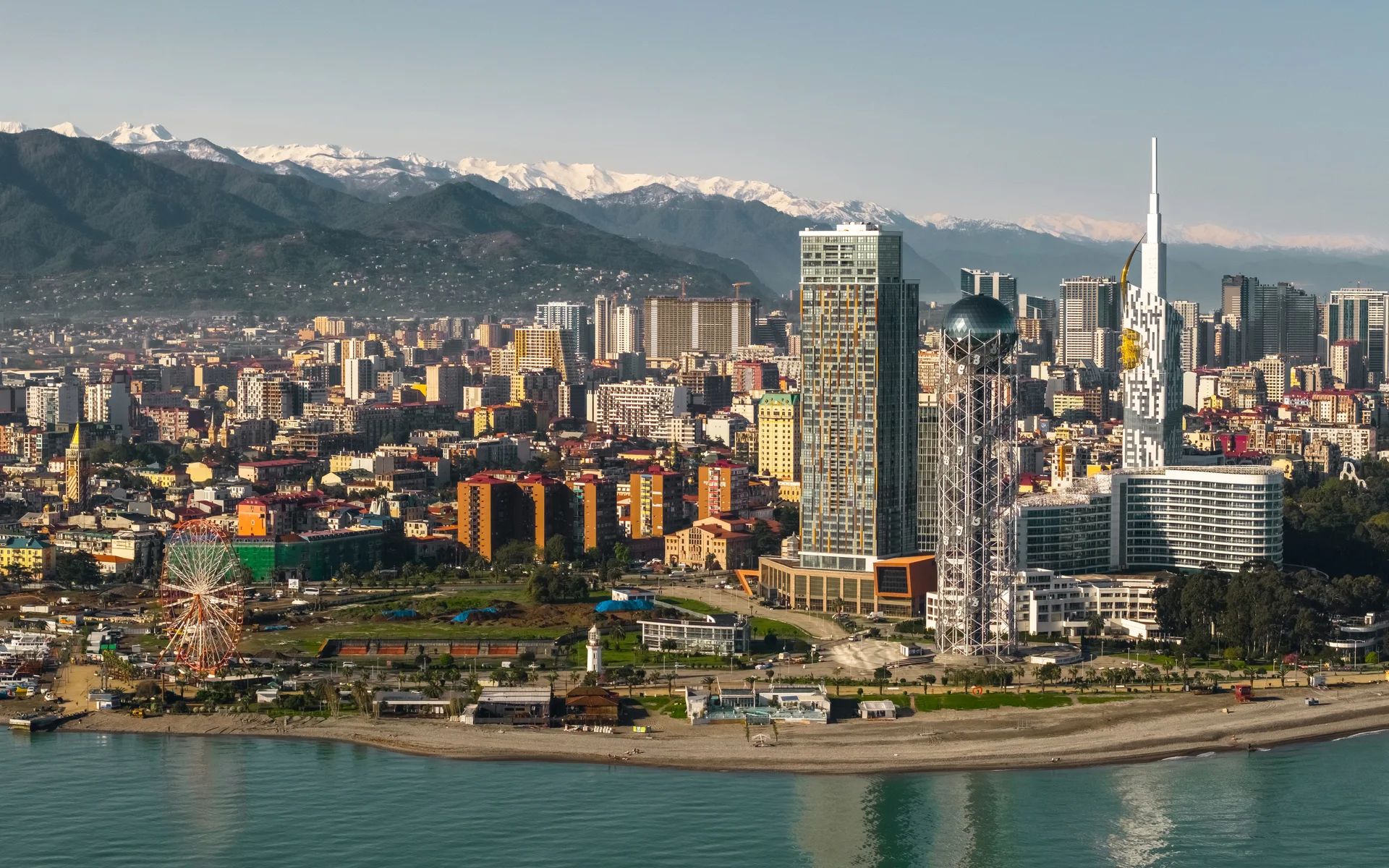
Batumi is a market where financial results are more strongly influenced by tourist flow, property quality, and the management model. According to TBC Capital and Sisno Group, the average property price in Batumi increased by 16.5% in 2025, reaching $1395 per square meter.
The average price of new apartments in Batumi in December 2025 was $1231 per square meter, with a year-on-year increase of 15.4%. It is also noted that part of primary market transactions is registered with a delay. Geostat indicates that in 2025, Adjara accounted for 25.7% of regional visits, the second highest figure after Tbilisi.
Kutaisi and Imereti

Kutaisi is often included in selections due to lower prices, which means there are fewer properties suitable for residence permits and they are harder to find. According to the distribution of visits in 2025, Imereti accounts for 11.1% across regions.
Step-by-step procedure for obtaining a residence permit through real estate purchase
The process of obtaining a residence permit in Georgia through real estate consists of several sequential stages. The first step is acquiring a property and registering it in the state registry.
How the process works:
- the property documents are verified;
- the sale and purchase agreement is signed;
- documents are submitted to the National Agency of Public Registry;
- the property is registered under the new owner.
What must be checked before purchase:
- the seller’s ownership rights are properly registered;
- there are no liens, arrests, or restrictions;
- the area and characteristics match the registry data;
- the property can be registered without additional conditions.
Once the property is registered in your ownership, its market value must be confirmed. The owner hires an appraiser, which typically costs between $100 and $300 and takes 2 to 5 working days.
If the valuation report confirms that the market value meets the $150,000 threshold, the applicant can proceed with preparing the document package for the residence permit application.
The basic set of documents includes:
- an international passport;
- proof of ownership;
- the valuation report;
- a completed application form;
- proof of residential address.
Additional documents may be required:
- photographs;
- translations of documents;
- proof of family status if family members are included in the application.
All documents must be valid and free of errors. Any discrepancies may lead to delays in processing. The application must be submitted through the Public Service Hall or the online government services system. In most cases, the initial application requires personal presence.
A state fee is paid upon submission, and its amount depends on the processing time:
- 30 days: 300 GEL ($110–120);
- 20 days: 450 GEL ($160–180);
- 10 days: 600 GEL ($210–230).
After approval, an additional fee is charged for issuing the residence card, ranging from $20 to $50 depending on urgency. Once the application is approved, the residence card is issued. The residence permit remains valid only as long as the underlying basis exists, meaning the property must remain in the applicant’s ownership and continue to meet the requirements.
The renewal procedure is similar to the initial application but is usually faster, as the applicant’s data is already in the system.
Author

I write informative articles about real estate, investments, job opportunities, taxes, etc.