










7 Airports Under Construction Around the World That Will Change Real Estate Markets in 2025–2030


Airports serve as major logistics and economic hubs, so their launch almost always triggers the development of surrounding infrastructure: from warehouse complexes, office districts, and technology parks to residential quarters of varying density.
In several countries where logistics and international business form a significant share of the economy, major corporate offices tend to cluster around key aviation nodes. Notable examples include Dubai South, Changi Business Park in Singapore, and the commercial districts built around the new Istanbul Airport.
However, even the most advanced airports eventually reach their capacity limits. When the modernization potential of an existing air hub is exhausted, governments are forced to choose another path: initiating the construction of a new airport, usually in a different part of the metropolitan area. This leads to a construction boom in the new location, the creation of entire districts from scratch, and years of accelerated growth in the local housing market.
In this report we have compiled the largest airports currently under construction, scheduled to open between 2025 and 2030. We examine the territorial and economic shifts they generate and how these changes may affect local real estate markets.
Megaprojects Reshaping the Global Real Estate Landscape in 2025–2030
Modern airport projects are rarely implemented from start to finish in one phase. They are usually launched gradually, with new terminals added to a central core. As a result, the most significant megaprojects of 2025–2030 are either already partially operational or in the final stages of their initial launch.
King Salman International Airport (Riyadh, Saudi Arabia)
King Salman is one of the largest infrastructure projects in the Middle East. It is being developed as part of the Vision 2030 strategy aimed at transforming Riyadh into a global economic hub.
The project covers roughly 57 square kilometers and includes six parallel runways, cargo terminals, logistics hubs, business clusters, and extensive land reserved for residential development.
By 2030 the airport is expected to serve up to 100 million passengers per year, with the figure projected to reach 185 million by 2050. Annual cargo throughput is more modest at about 3.5 million tons.
According to forecasts by urban research centers, the regional labor force in the Riyadh area may grow by 16 to 23 percent by 2030, creating demand for about 300 thousand additional housing units within the capital and adjacent areas. Around 12 square kilometers have already been reserved for residential construction inside the project.
Developers are proactively acquiring land plots along future transport corridors, targeting long-term demand from logistics operators, service companies, and high-tech manufacturers. In parallel, demand is rising for midrange and upscale residential projects. Over time the district may evolve into a standalone economic subcenter of Riyadh similar to Dubai South with its own office, residential, and industrial infrastructure.
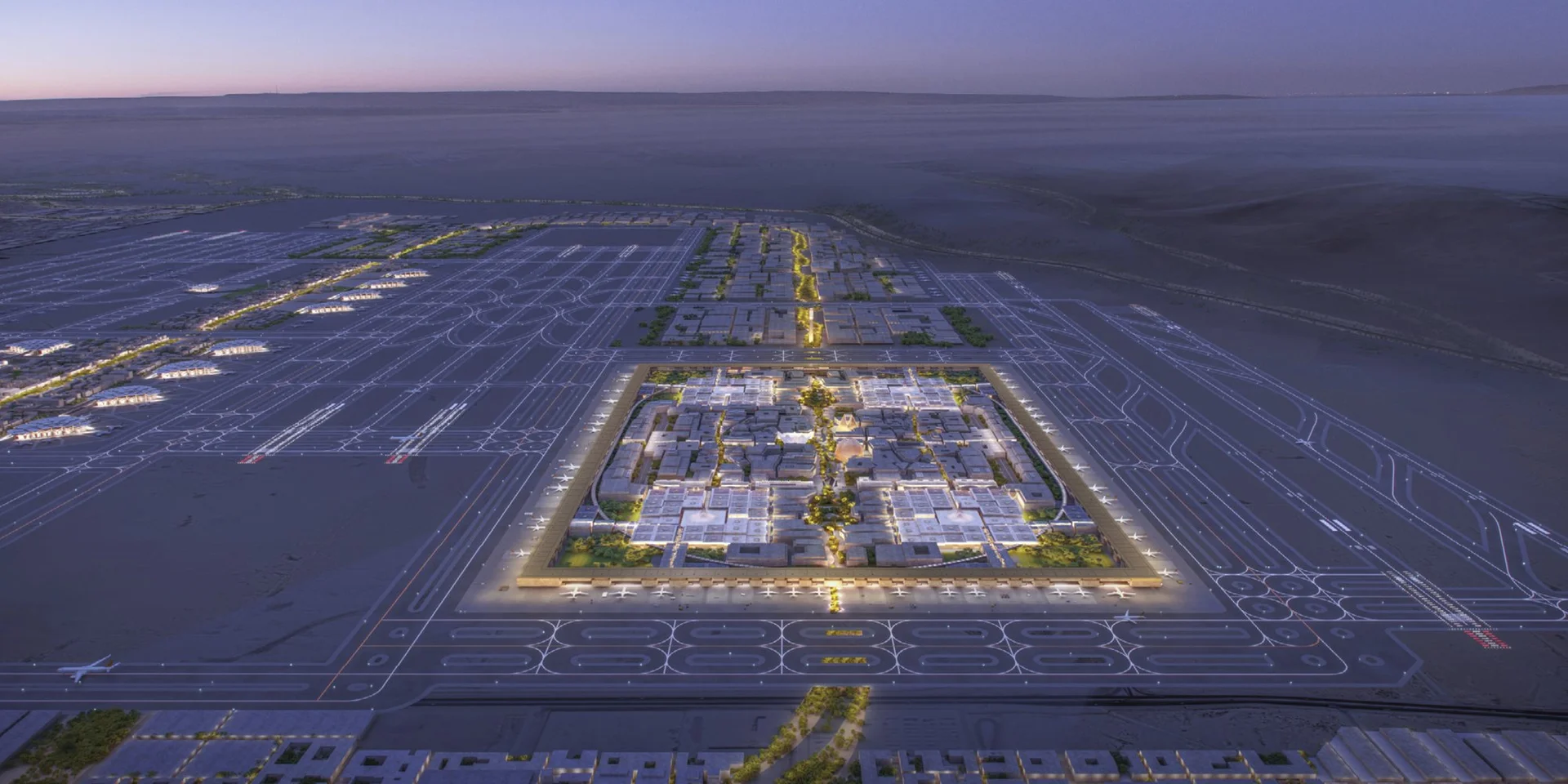
Photo source: buyingbusinesstravel.com.ru
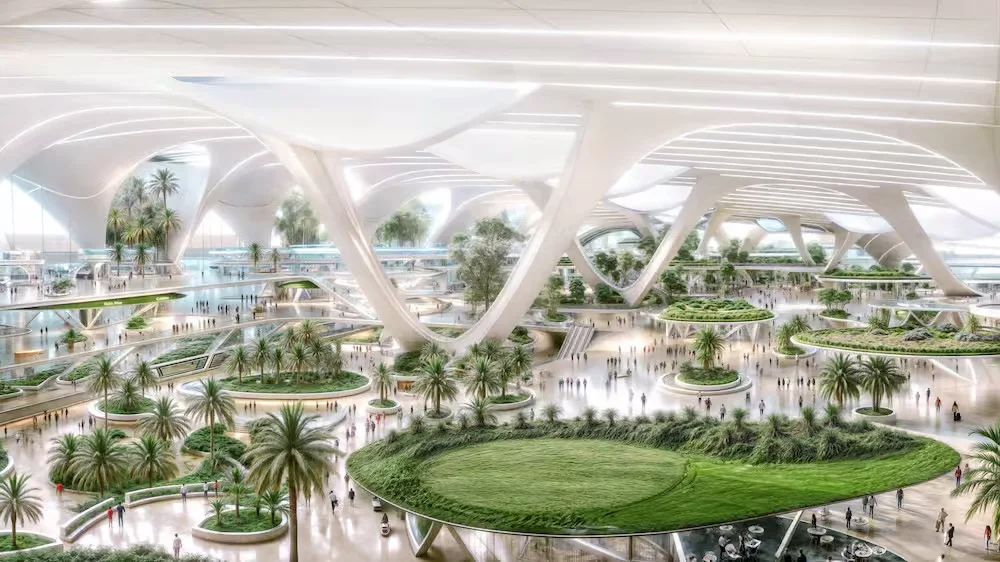
Al Maktoum International Airport (Dubai World Central), Dubai, UAE
The expansion of the existing Al Maktoum International Airport is one of the key development phases for the southern part of Dubai. The project is valued at about 35 billion dollars and is intended to create the world’s largest aviation complex with a long-term focus on transit passenger and cargo flows.
Key projections:
- The large-scale Dubai South development program envisions an integrated city with a population of more than one million people that will include housing, business clusters, logistics zones, and technology parks.
- According to estimates by analytical agencies, average annual housing price growth in Dubai South is expected to reach 15 to 20 percent in the coming years.
- The region is actively attracting logistics, technology, and e-commerce companies that require close access to international cargo flows and dry ports.
- At the same time, the transport network is expanding with new interchanges and planned additions to the public transit system, which significantly increases the district’s appeal for permanent residents.
Dubai South is becoming a new population center in the south of the emirate. Job creation is driving stable demand for midrange housing, although low-rise developments, townhouses, and villa communities are expanding just as actively.
Commercial real estate is experiencing elevated demand because of the concentration of companies linked to aviation services, export operations, and online retail.
Navi Mumbai International Airport (NMIA), Mumbai, India
Mumbai’s main airport, Chhatrapati Shivaji Maharaj (CSMIA), has been operating at its limits for many years. In 2025 it recorded over 1,030 takeoffs and landings within a single day, which became a notable record.
Modernization of the existing airfield did not resolve the issue. There is no free land for major expansion, and additional runways or terminals are constrained by dense urban development and ecological restrictions.
This led to the decision to build a new airport on open land in the Ulwe and Panvel areas. This approach makes it possible to plan parallel runways from the start along with modern logistics and new adjacent development aimed at supporting metropolitan growth rather than merely serving the historic center.
Construction is divided into phases. The first stage includes one runway and one terminal designed for up to 20 million passengers per year. The airport officially opened in October 2025, and scheduled flights are being introduced gradually in 2025–2026 with a steady rise in daily operations.
Full capacity is expected by 2032 with a projected passenger throughput of 90 million per year and 2.5 to 3.2 million tons of cargo. NMIA is planned not as an auxiliary facility but as the future primary gateway of the megacity, with part of the international and domestic traffic gradually shifting here.
A set of major transport projects is tied to the new hub:
- The Mumbai Trans Harbour Link (MTHL) has opened. It reduced travel time from South Mumbai to the airport zone to about twenty minutes, although traffic congestion on the approaches remains a challenge.
- Metro lines and rapid bus routes are planned to connect NMIA with key districts of the old city and its business centers.
- A cluster of hotels, offices, and commercial areas is being built next to the airport to serve transit passengers, business travelers, and corporate tenants.
The real estate response began long before the airport’s actual launch. Since the activation of the project:
- Property prices in Ulwe, Dronagiri, Pushpak Nagar, and Panvel have risen by roughly 30 to 50 percent due to speculative demand, land acquisitions by developers, and expectations of future growth.
- Certain micro locations in Ulwe, Uran, Panvel, Kharghar, Taloja, and Dronagiri have shown land price jumps of 50 to 90 percent in the most promising areas, especially near transport corridors leading to the airport.
- In Panvel and New Panvel analysts expect prices to climb by 40 to 80 percent once the airport reaches stable operational capacity.
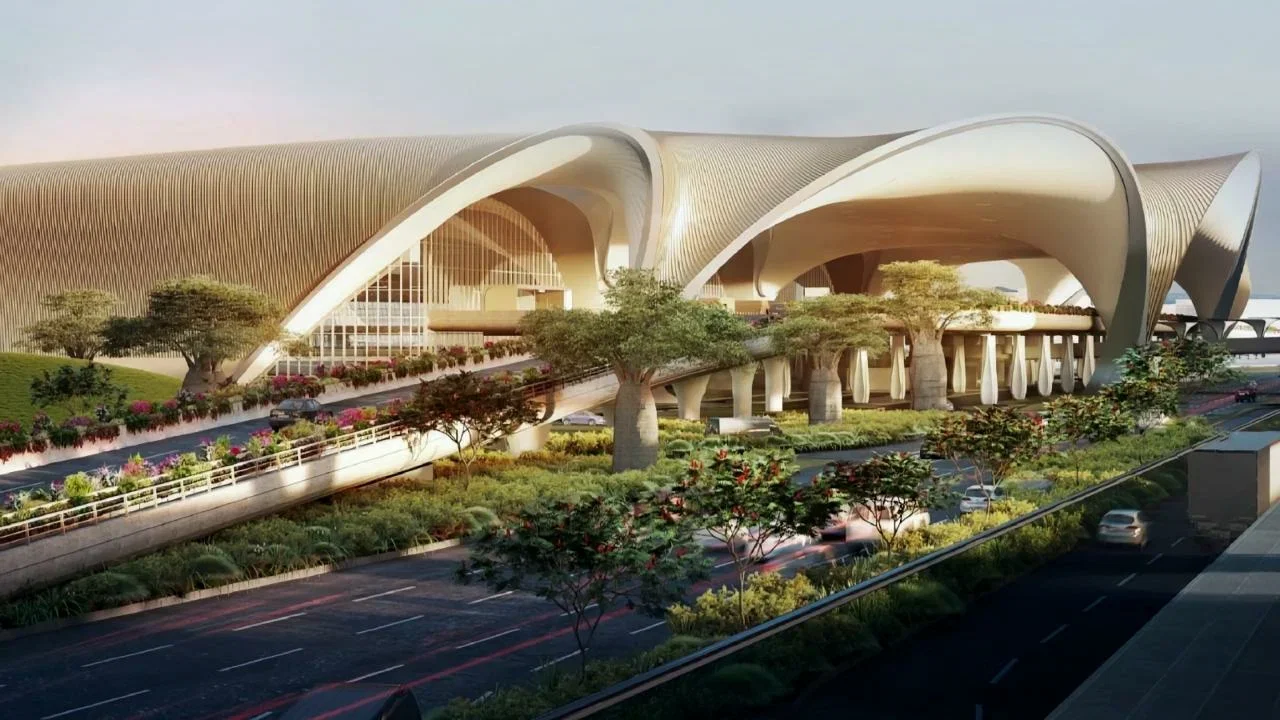
Photo source: travel.yandex.ru
Noida International Airport, Delhi, India
Noida International Airport (Jewar) is one of the largest infrastructure projects in Northern India. It is a completely new airport designed to relieve the country’s busiest transport hub, Indira Gandhi International Airport (IGIA), which remains India’s primary aviation gateway.
The airport is being built in several phases:
- Phase I (current stage). Capacity of 12 million passengers per year with one runway and one passenger terminal.
- Phase II (by 2028). Commissioning of the second runway and expansion to 30 million passengers annually.
- Phases III–IV (by 2040–2045). The total number of runways will increase to four with a planned annual capacity of 60 to 70 million passengers.
The airport is integrated into a large-scale infrastructure program initiated by the state of Uttar Pradesh. The launch of Jewar acts as a catalyst for an entire network of new roads and transport corridors:
- Yamuna Expressway is becoming the primary business corridor between Delhi and Agra.
- A high speed rail line is planned with a station at the airport.
- The Noida Metro Extension project, now under evaluation, will create a direct connection to Noida’s business districts.
- New highways are being laid to link the airport with Gautam Buddh Nagar, Ghaziabad, and the eastern districts of the NCR.
Impact on the real estate market:
- Land prices along the Yamuna Expressway have increased by 40 to 60 percent in the most promising sectors over the past few years.
- The residential market of Greater Noida is seeing an influx of development projects aimed at professionals who will work in emerging industrial clusters.
- Areas near future YEIDA interchanges are recording growing demand for commercial plots intended for office buildings, hotels, and service facilities.
- Investors are actively acquiring plots in sectors 17, 18, 20, and 22, which are shaping into a future zone for business, retail, and mixed-use development.
- At the current stage demand is primarily investment driven, but as the airport enters regular operation, a fully fledged residential market focused on long-term living will begin to form.
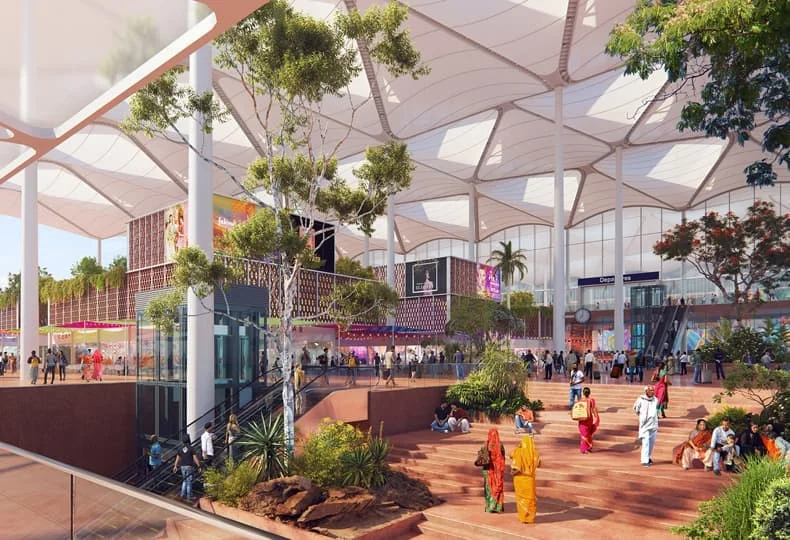
Photo source: design-mate.ru
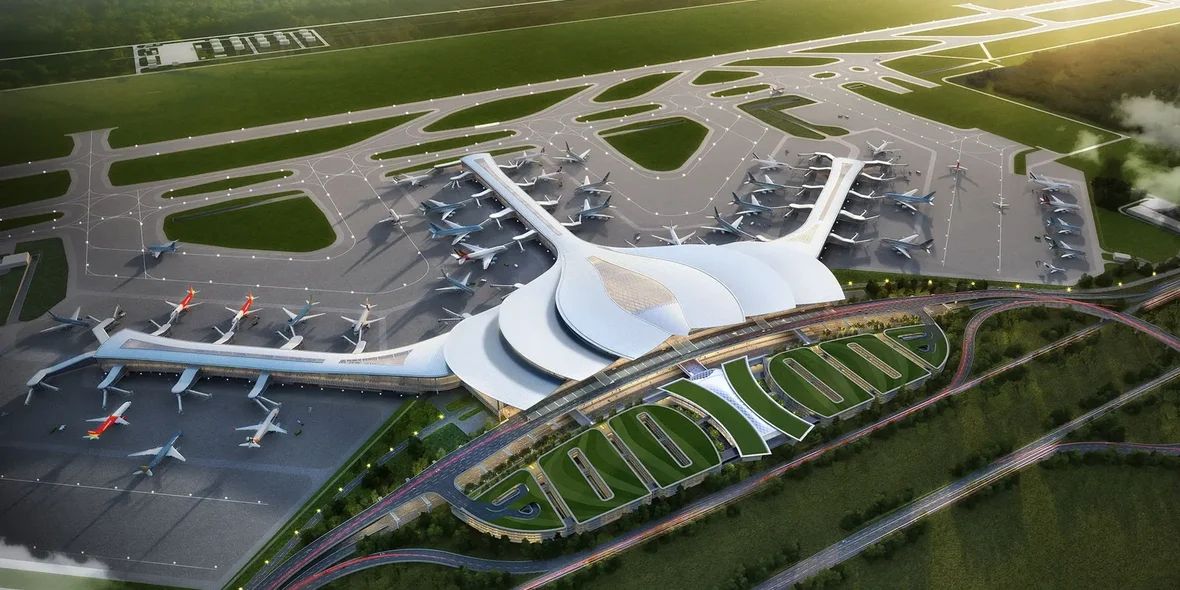
Long Thanh International Airport, Vietnam
Long Thanh International Airport is the largest infrastructure project in Vietnam and one of the most ambitious aviation hubs in Southeast Asia. Its launch fundamentally reshapes development patterns in the southern metropolitan region, shifting the center of gravity for housing, commercial real estate, and industrial growth from overcrowded Ho Chi Minh City toward Dong Nai Province and the adjacent Ba Ria – Vung Tau area.
Ho Chi Minh City’s existing airport handles more than 40 million passengers per year despite a design capacity of about 25 to 28 million. It has long exhausted any possibility of expansion: dense residential quarters and commercial districts surround the airfield, and there is no reserve land for new runways.
The southern region accounts for the bulk of the country’s industrial output and export capacity. The growth of manufacturing, foreign trade, and inflows of direct investment has created the need for a modern air hub with a strong cargo sector.
Long Thanh is also being implemented in stages:
- Phase I (expected launch 2026–2027). One runway and one modern terminal with an initial capacity of 25 million passengers per year and roughly 1.2 million tons of cargo.
- Phases II–III (by 2035–2040). Two parallel runways and an expanded taxiway system. Capacity will increase to 50 million passengers annually.
Full capacity is planned after 2040. In its completed form the airport will have four runways, several cargo and passenger terminals, and a total throughput of 80 to 100 million passengers per year.
The project is accompanied by major upgrades to the transport network:
- The Bien Hoa – Vung Tau highway is being modernized to provide a direct link between the airport and coastal industrial zones.
- The Ho Chi Minh City – Long Thanh – Dau Giay expressway is being expanded and is becoming the main corridor between the megacity and the new hub.
- A Ho Chi Minh City – Nha Trang railway line is being planned with a branch to the airport.
- Parallel investments target port upgrades and new logistics complexes, turning Long Thanh into a key element of the unified transport and logistics chain in southern Vietnam.
- Industrial parks are already being built or planned along the main highways, tailored to export-oriented sectors such as electronics, pharmaceuticals, machinery, food distribution, and container logistics.
- The project includes the development of a business district near the airport with office centers, hotels, exhibition facilities, and airline service hubs.
As a result, Dong Nai Province, previously seen as a suburban industrial area, is becoming one of the fastest-growing development zones in Vietnam. Land prices in Long Thanh, Cam My, and Nhon Trach have already increased by 35 to 60 percent within just a few years.
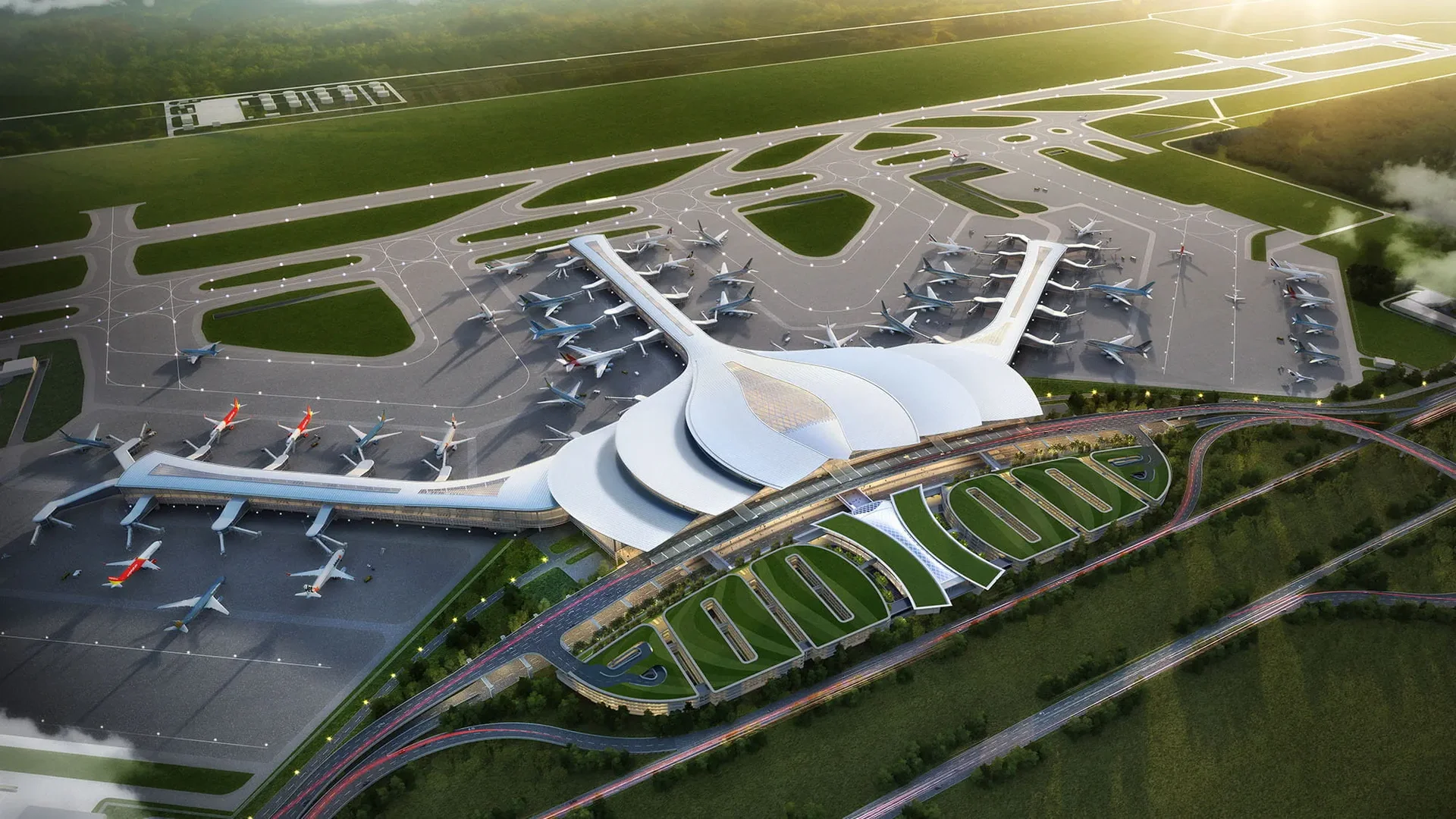
Photo source: arup.com
New Manila International Airport (NMIA), Philippines
New Manila International Airport (Bulacan) is being built as a key element of the Philippine government’s long-term strategy to relieve the capital region and create a new transport and economic center north of Manila. Construction of NMIA is driven by a set of issues that have been accumulating for decades:
The existing Ninoy Aquino International Airport (NAIA) is considered the third busiest in Southeast Asia, yet it is also one of the least technologically advanced. It has only three runways that operate close to maximum capacity.
Physical expansion of the airport is impossible while both population and passenger numbers continue to rise. As a result, its design capacity of 30 million passengers has long been exceeded, with current annual levels reaching 45 to 50 million.
The capital is confined between the bay and the eastern mountains, and most suitable land for projects of this scale is already occupied. The transport system is overloaded, and any new construction near the old airport causes even greater congestion. For these reasons the new airport is being built about 35 kilometers north of Manila.
Key figures:
- Four parallel runways are planned, designed to handle high-density traffic simultaneously.
- Initial capacity is set at 35 to 50 million passengers per year.
- Full capacity is projected at 100 to 120 million passengers annually, placing NMIA among the largest hubs in the region.
The project includes a major transport network aimed at connecting the new airport with the entire northern part of Luzon:
- The North Luzon Expressway (NLEX) will receive new interchanges and direct access to the airport.
- A railway line from Manila to Bulacan is planned with integration into the North South Commuter Railway system.
- A network of new access roads will link NMIA with the provinces of Pampanga and Tarlac.
- Direct connections are planned with key metro districts such as Makati, Bonifacio Global City, and Quezon City.
The project includes the creation of an “aerotropolis” that will function as a full-scale urban cluster around the airport with office centers, technology parks, hotels, and residential districts.
The real estate market began reacting to the project about a year before construction started in 2020. Land prices in the municipalities of Bulacan and Manila have increased by 30 to 50 percent in recent years, and in some micro locations the growth has reached up to 70 percent.
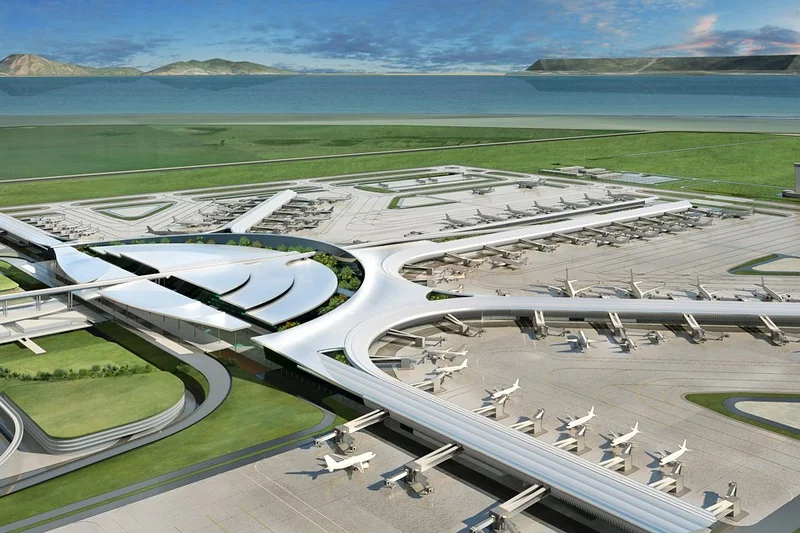
Photo source: futuresoutheastasia.com
Techo International Airport, Phnom Penh, Cambodia
Techo International Airport is Cambodia’s new capital airport, built entirely from scratch on a site of about 2,600 hectares (around 26 square kilometers) in Kandal Province about 19 to 20 kilometers south of Phnom Penh. It is one of the country’s largest infrastructure projects, with an investment volume estimated at 2 to 2.3 billion dollars.
On 8 September 2025, the old Phnom Penh International Airport was closed for commercial flights, and on 9 September, the new airport began regular operations. The official inauguration took place later on 20 October 2025.
The project serves several strategic objectives:
- to create long term capacity reserves up to 2050;
- to form a new economic activity center south of the capital;
- to anchor future logistics, industrial, and residential clusters around the airport.
Techo International Airport has been designed from the outset as a three-phase megaproject:
- Phase I (current stage): one runway and a terminal designed for up to 13 million passengers per year, compared with about five million at the old airport.
- Phase II (by 2030): expansion of the terminal and supporting infrastructure with capacity rising to 30 million passengers.
- Phase III (by 2050): planned capacity of up to 50 million passengers annually and up to three runways.
TIA is not limited to a terminal and runways. The surrounding development is planned as a full urban zone similar to other next-generation airport projects. The plan includes:
- commercial and office districts;
- residential areas of varying density;
- recreational spaces, including a major park and an artificial lake;
- an exhibition center, warehouses, factories and logistics facilities in industrial zones;
- a future high-speed rail link integrating the airport into the national transport network.
Along the perimeter of the new airport and around Ring Road 3, several notable market trends are being recorded:
- When the project was announced in 2018, land that typically sold for one to two dollars per square meter was already being resold for eight to nine dollars.
- In 2024–2025 most listings appeared with tags such as “for warehouse development” or “future residential use.” These are usually plots located four to five kilometers from the airport and one to two kilometers from Ring Road 3, priced at about 68 dollars per square meter.
- Some plots in the “New Techo International Airport Area” are already being offered at 160 dollars per square meter.
- Commercial land along key highways reaches 300 to 360 dollars per square meter.
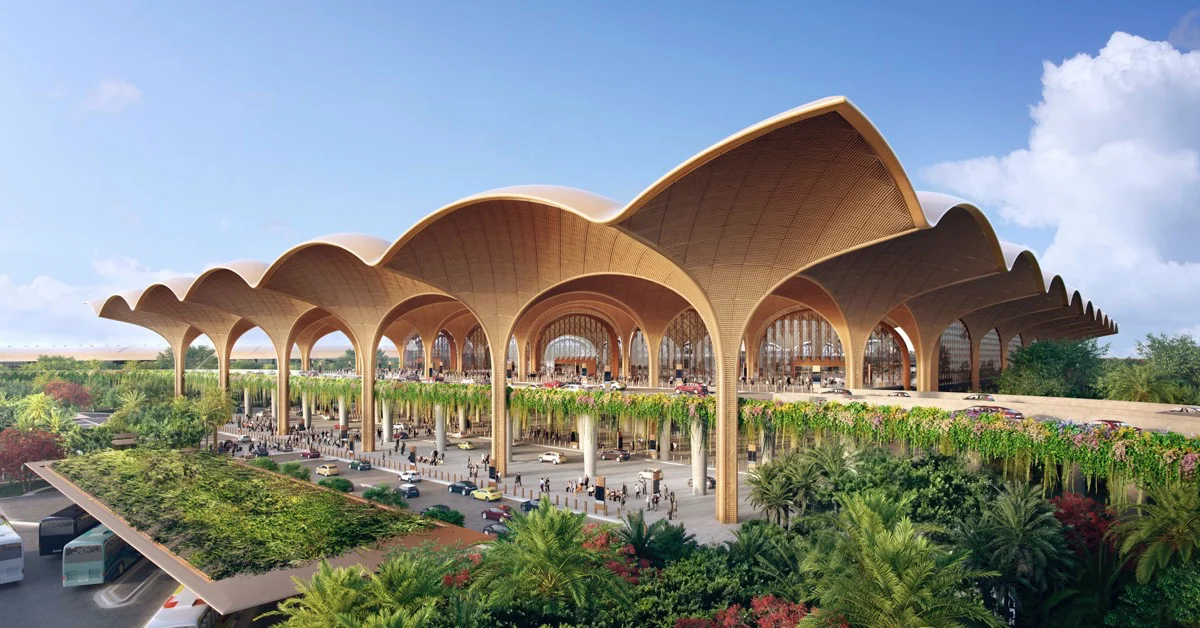
Photo source: buyingbusinesstravel.com.ru
Summary
The construction of new international airports in 2025–2030 is indeed a transformative factor for real estate markets, largely due to the rise of the aerotropolis concept. In the past airports were placed on the urban periphery far from residential areas, but now full-scale urban systems are being formed around them that include office and industrial zones, residential districts, and clusters for education and services.
In countries with rapid demographic growth and industrialization, such as India, Vietnam, and the Philippines, airports are shaping new infrastructure belts around Mumbai, Delhi, Ho Chi Minh City, and Manila. In resource-driven economies that focus on megaprojects, especially in the Middle East, separate urban centers are emerging that may eventually rival the cities they were originally built to support.
These dynamics are attracting investors, since the emergence of fast-growing zones creates strong opportunities to invest in real estate or in the land that will underpin its development.
Author

I write informative articles about real estate, investments, job opportunities, taxes, etc.