








Land in Montenegro: Prices, Areas, and How a Foreigner Can Buy a Plot


The land market in Montenegro has entered a new phase of development — over the past year, prices have risen by an average of 20.8%, and on the coast by almost 50%. Previously, foreigners mainly bought ready-made apartments in Budva or Tivat, but now more and more investors are looking specifically at land plots.
In this article, Slava Maevski, founder of MD Realty with 15 years of experience in the Balkans, explains where and how to buy land, which documents must be checked, and why 80% of plots have some nuances that the seller may “forget” to mention.
Also, read our analytical material on how much families earn and spend in Montenegro.
Current Situation on the Montenegro Land Market
For a long time, investor interest was focused on apartments in coastal cities — Budva, Tivat, and Kotor. However, today the main growth driver is precisely the land plot market.
It is being shaped by several factors. After the breakup of Yugoslavia, many lands were privatized by private owners, leading to strong fragmentation. Now, inherited plots are increasingly coming onto the market — owners are relocating, lack the means to develop the land, or simply prefer to convert the asset into cash. This creates a wide supply, including in rare and previously inaccessible locations.
Urban Development and EU Integration Influence
Montenegro is actively urbanizing. Municipalities regularly revise territorial plans, incorporating lands previously classified as agricultural into building zones. This creates a constant flow of new offers.
In Budva, Bar, Tivat, and Podgorica, local authorities are working on new DUPs (Detailed Urban Plans). Each approved plan immediately triggers a new wave of offers. For an investor, it’s crucial to monitor these documents — they determine what can be built and whether anything can be built at all,” explains Slava Maevski.
At the same time, economic expectations are strengthening — Montenegro has been in the EU accession process for several years. Based on the experience of Croatia and Slovenia, EU entry leads to a significant increase in real estate prices. Many investors, especially from Germany and Switzerland, view land purchases here as a strategic investment for a 5–10-year horizon.
Who Is Buying Land in Montenegro Today
The buyer profile is becoming increasingly international. According to MD Realty data, the most active remaining citizens of Serbia and Turkey — the former feel cultural and linguistic closeness, the latter are looking for an alternative to overheated Mediterranean markets.
Investors from the USA and Germany see Montenegro as a promising analog of Croatia, where they can enter at an early growth stage. Clients from the UAE and the UK are primarily interested in plots near premium projects, including Porto Montenegro.
Buyers from Eastern Europe most often build homes for personal residence or relocation. Local residents are also increasingly turning to land purchases, viewing small plots as a capital accumulation tool or future income source through tourist rentals.
How Land Is Classified and What Can Actually Be Bought
In Montenegro, the key factor is the land status — whether it is urbanized or not. A Detailed Urban Plan (DUP) grants the right to build according to clear rules and boundaries.
“We always explain to clients: if the documents do not mention a detailed urban plan, construction on the plot is not allowed. Sometimes buyers fall for beautiful views and low prices, only to later discover that the plot is agricultural and any construction is legally restricted. That’s why the first thing we do is request Urban-Technical Conditions (UTU) and the Detailed Urban Plan (DUP),” says Maevski.
Urbanized plots are available to foreign individuals up to 5,000 m². To purchase larger areas or non-urbanized land, registration of a company in Montenegro is required — a simple and standard procedure for investors.
Geography of Demand: From Budva to Mountain Valleys
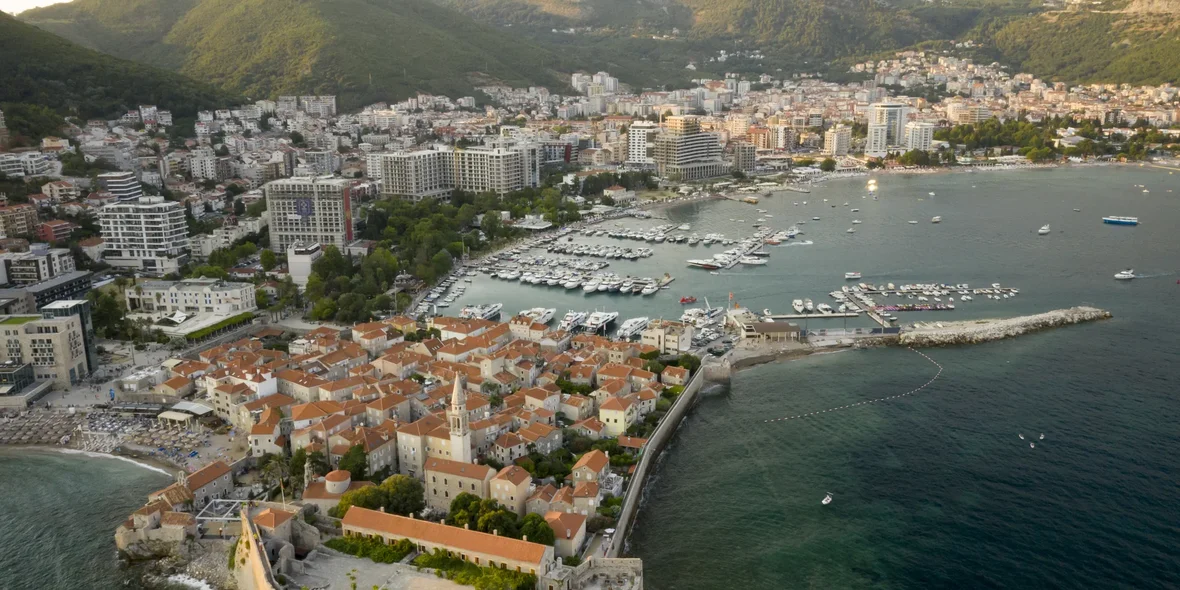
The leader remains the Budva Riviera — the heart of tourist activity. Plots here cost from €200 to €900 per m², and on the first sea line prices can reach €3,000.
Boka Kotorska Bay, especially Tivat and Kotor, attracts lovers of comfort and history. Projects near Porto Montenegro enjoy special demand among investors from the UAE and Western Europe. Prices from €250 to €700 per m², premium — higher.
Bar and Ulcinj represent a more affordable segment. Here you can find plots from €100 per m², while the sea is still nearby and infrastructure is actively developing.
In central and northern regions — Danilovgrad, Cetinje, Žabljak, Kolašin — land is significantly cheaper, but interest is growing due to ecotourism, ski projects, and organic farming. Plot prices start from €50 per m².
“Žabljak and Kolašin are no longer just mountain villages — they are the future Alpine resorts of the Balkans. We see interest in building chalets, apart-hotels, and recreation bases. For a long-term investor, this is an excellent entry point,” notes the expert.
Legal Transparency in the Montenegro Market
In recent years, the legal side of the market has become much clearer. All transactions go through notaries, data is recorded in the cadastre, and government agencies provide online access to information about owners and encumbrances.
“A few years ago, you could buy a plot and then unexpectedly discover a court seizure or heirs who ‘remembered’ the land. Today, such cases are rare, but verification is still mandatory. At MD Realty, we do not take on any object without a current List of Immovable Property and full cadastral checks,” emphasizes the expert.
Since August 2025, a new law on property legalization has come into force in Montenegro, completely changing the registration procedure. Now, houses built in violation of urban planning norms simply cannot be registered — such objects cannot be the subject of a transaction. This means that “gray” real estate is effectively excluded from circulation: notaries and banks work only with projects that have passed all stages of approval and verification.
Pitfalls: What Can Go Wrong
Despite improvements, the land market remains complex. According to MD Realty estimates, up to 80% of plots have certain nuances: from uncoordinated access roads to cadastral errors.
One of the most common problems is access to the plot. Sometimes the only driveway runs through private land — today the owner allows passage, tomorrow he may not. This significantly reduces the value of the object.
Other risks include encumbrances (mortgage, court seizure), disputed boundaries, and purchasing plots in the Morsko Dobro zone — the coastal strip where construction is prohibited by law.
Also consider utility connection costs. If the plot lacks nearby access to electricity or water, connecting networks can cost tens of thousands of euros.
Investment Potential: Figures and Reality
According to MD Realty, in 2024, the average price increase for real estate was 20.8%, and on the coast, almost 50%. In 2025, further growth is expected, especially in Budva and Tivat — up to 15%.
Foreign investment in real estate in just the first five months of 2025 exceeded €190 million — and we are talking specifically about long-term projects: villas, apart-complexes, resort residences.
Main growth drivers: approaching EU membership, limited coastal land supply, tourism development, low taxes (9% on profit and income, no inheritance tax), and a stable currency — the euro.
Investor Recommendations
Drawing on more than 15 years of experience in the Montenegro and Balkan real estate markets, Slava Maevski highlights several key principles he calls the “golden rules” of a successful investor:
- Check documents personally or through a lawyer. Do not trust scanned copies — only the official List of Immovable Property from the cadastre.
- Study the urbanization status. Without an approved DUP, construction is not allowed.
- Check access roads and utilities. Also, do not forget about the terrain and subsequent earthwork costs — this can be the most expensive part of the project.
- Work only with agencies that take responsibility for legal purity.
- Think strategically. Land in Montenegro is not a one-year speculation — it is an asset for a decade.
Leave a request
Author

I am responsible for editorial work. I write expert interviews and guides.