









The Most Unusual Apartments in the World: Housing in Shopping Malls, Factories and Boeing 727


Urban infrastructure changes constantly. Buildings that once stood on the outskirts of a city are now surrounded by residential blocks and supermarkets. If the structure is a former church or an old printing house, it may be demolished and replaced with new construction.
However, many entrepreneurs realized that reusing an existing building is more cost-efficient than erecting one from scratch. Developers are entrepreneurs as well, so even the workshops of a closed factory can be transformed into a compact residential building.
In this article, we explore the most interesting residential projects whose original purpose had nothing to do with housing.
Also read our text about the most unique and unusual buildings in the world.
When Retail and Industrial Architecture Becomes Living Space
After 2020, about 25 percent of large shopping malls in Europe and North America lost their main tenants, and large areas remained vacant. Developers began considering conversion into housing. The process turned out to be more complex than planned. Shopping centers were designed for heavy foot traffic, with little natural light in central zones and many technical facilities.
To convert them into residential buildings, architects had to:
- Add skylight shafts in the roof so every apartment has access to natural light.
- Reconfigure the layout and remove unnecessary equipment such as escalators because they take too much space.
- Redesign engineering systems that were intended for retail areas and did not include isolated risers or smoke removal systems.
- Improve sound and thermal insulation. Large retail buildings have a single thermal envelope; it is divided into separate blocks to reduce heating costs.
Advantages of such projects include a lower price per square meter, on average 20 to 25 percent cheaper than new construction, and the fact that large parking lots and public transport stops are already in place. A disadvantage is that the layouts offer limited flexibility because they depend on the initial geometry and size of the retail floor area.
Lofts in Industrial Buildings
Industrial facilities became a classic redevelopment format in the 1980s. The first large conversions appeared in New York in former textile factory buildings. According to New York City Planning, by 1990 more than 1.1 million square meters of former industrial space had already been converted into housing.
Architecturally, these buildings are ideal for adaptation:
- Frame structure. Reinforced concrete and steel columns spaced 5 to 6 meters apart carry the main load, which leaves an open floor plate that can be redesigned freely.
- Large window openings. Factory standards required natural light for workstations, so glazing often covers 40 to 50 percent of the facade.
- High ceilings. The average height ranges from 4.2 to 6.5 meters, which allows for mezzanines and two-level apartments.
A typical example is the industrial blocks in Berlin’s Friedrichshain district or the Royal Mills complex in Manchester, built in 1853. After renovation it includes 370 residential units while preserving original cast iron columns and brickwork.
The key feature is the cost. Renovating one square meter often exceeds the price of new construction because floors and facades need reinforcement and restoration. Still, such properties are viewed as unique and even prestigious, so their market price is usually 15 to 30 percent higher than apartments in a new building of the same class.
Unique Residential Projects
Separate from the earlier examples are contemporary buildings with unconventional layouts. Developers in the UAE are known for ambitious designs, including horizontal skyscrapers, but this section focuses on other pioneering projects.
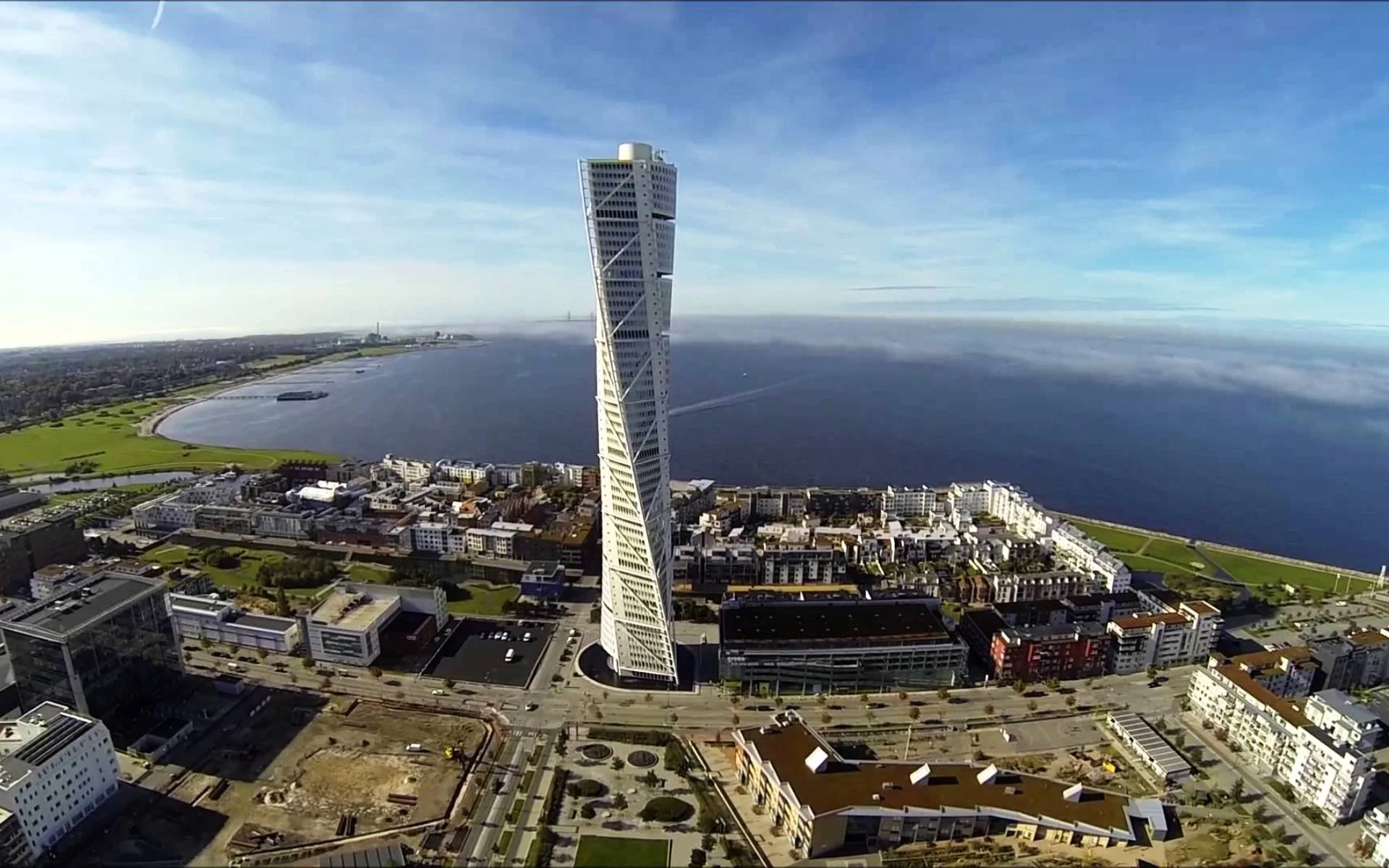
Turning Torso, Malmö (Sweden)
Turning Torso is one of the most recognizable examples of modern residential towers. Designed by Santiago Calatrava and completed in 2005, it was part of the Western Harbour Renewal program intended to transform Malmö’s former port area into a residential district.
The 190-meter building consists of nine segments, each containing five floors. Every segment is rotated by 10 to 13 degrees relative to the one below, creating a total twist of 90 degrees from base to top. The structural system is based on a steel central core with external truss sections attached to it. The tower is engineered to withstand coastal wind speeds of up to 35 meters per second, typical for the Baltic Sea region.
The building contains 147 apartments, office space, and technical floors. Apartment sizes range from 70 to 190 square meters, and all layouts are unique. From a financial perspective the project proved successful. Within two years all units were sold, and the tower became a major landmark of Malmö.
La Muralla Roja, Calpe (Spain)
Architect Ricardo Bofill completed La Muralla Roja (The Red Wall) in 1973. Since then the complex has become a textbook example of postmodern residential architecture. Located on the Costa Blanca in Calpe, it includes only 50 apartments, but the visual composition is the main attraction.
The building resembles a spatial puzzle with intersecting staircases, terraces, and bridges. The color palette combines red, purple, and blue tones. Warm colors are used on external walls, and cool tones in interior courtyards, which enhances the perception of depth.
Apartments range from 60 to 120 square meters and are planned with emphasis on natural light and cross ventilation. The roof accommodates pools and sun terraces, and the ground level includes commercial space.
La Muralla Roja was created as a statement against the uniform mass housing of the 1970s. It is now protected as an architectural heritage of the Valencian Community.
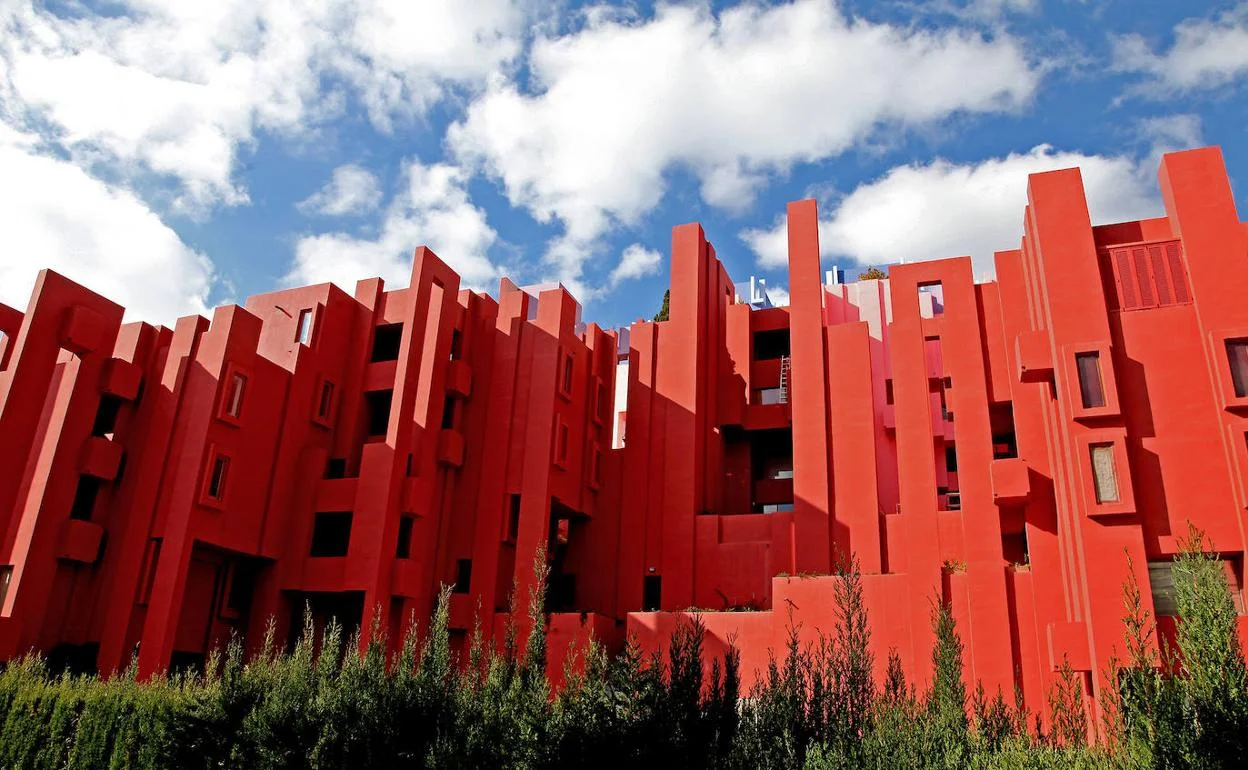
photo sourse: lasprovincias.es
Habitat 67, Montreal (Canada)
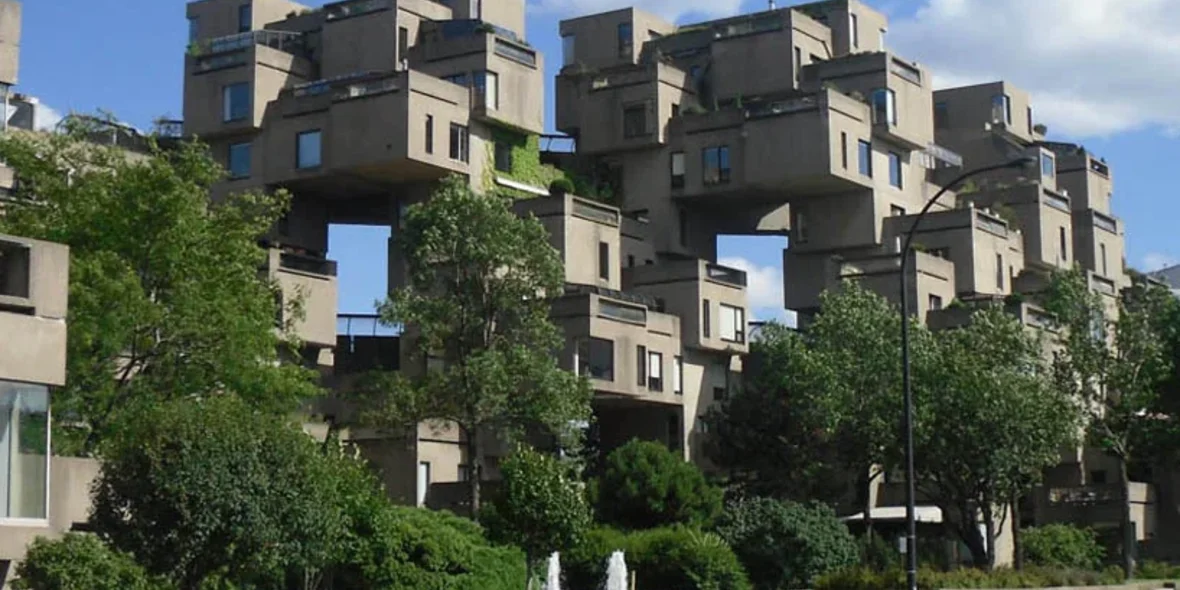
Designed by architect Moshe Safdie for Expo 67, the project became one of the first experiments in modular housing. The complex consists of 354 prefabricated concrete modules assembled into 146 apartments. Every apartment has its own terrace or a roof garden placed on top of the module below.
Each module has an area of about 56 square meters and can be combined with others to form units of various configurations. Visually the building looks like stacked blocks of a giant construction toy. Despite its unusual shape, the structure is stable and resistant to wind and temperature fluctuations. Modules are linked with steel anchors and concrete inserts.
The concept was originally intended as an affordable model for large-scale urban development. However, the high construction cost, around 140,000 USD per module, prevented wider adoption. Habitat 67 nevertheless became the foundation for modern modular housing concepts.
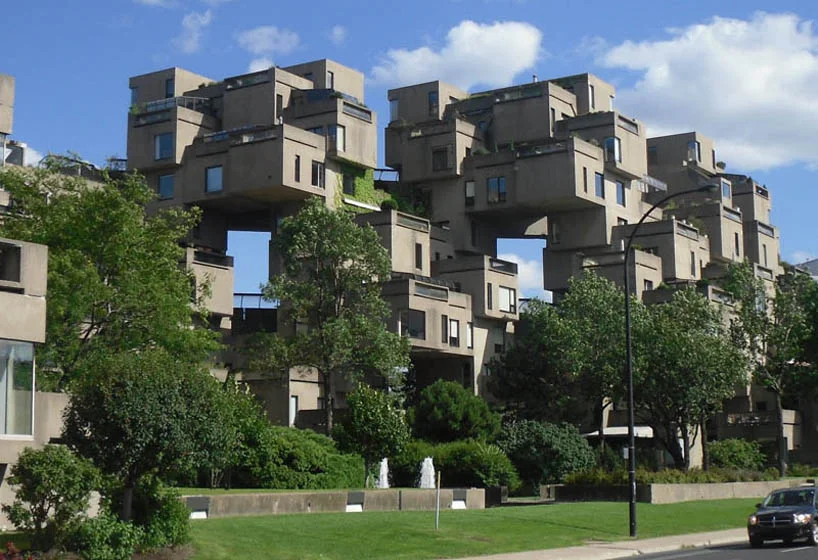
photo sourse: mapledip.com
Housing in Structures that Originally Had Nothing to Do with Architecture
There are even more unusual trends, although they are smaller in scale. One of the most surprising examples is converting retired passenger aircraft into housing (Boeing 727, Boeing 737, and Douglas DC-6).
In the United States and the Netherlands there are small residential complexes with a few apartments based on decommissioned airliners. The reason is the relatively low price of a retired aircraft. A fuselage without engines or electronics can cost from 30,000 to 70,000 USD, which, even with later investment, is cheaper than an apartment.
Most aircraft homes are used as short-term rentals, but some are private residences. The main drawback is the durability. Duralumin is less resistant to long-term corrosion than steel or concrete.
Housing in Castles
The conversion of historic defensive structures into residential property has formed a separate segment of the European real estate market. The trend emerged because Europe has a large stock of heritage architecture, and its maintenance is expensive. In the United Kingdom alone, up to 50 castles and manor estates are offered for sale each year to private buyers or for residential redevelopment projects.
A key restriction is that load-bearing walls cannot be altered. Heritage status obliges the owner to preserve original facades and planning elements such as pointed arch windows and ceremonial staircases.
One illustrative example is Pitreavie Castle in Scotland. It was built in the seventeenth century, later lost its purpose, and in the early twenty-first century was renovated and divided into six residential units. Today it functions as a high-end housing complex.
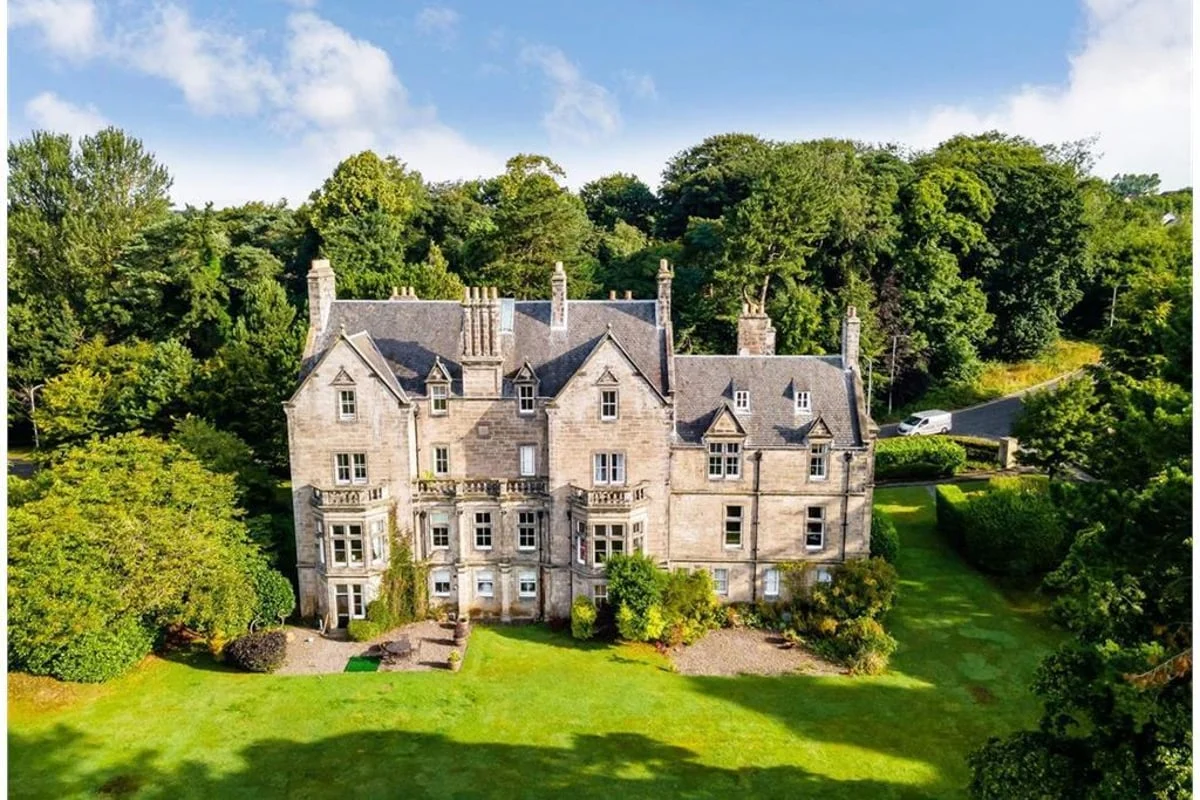
photo sourse: scotsman.com
Housing Inside Rock or Underground
Residential spaces integrated into the natural landscape also exist. These are fully legal homes with utilities. The most striking examples are:
- Coober Pedy, Australia. The town in South Australia emerged in the early twentieth century near opal mines. Around 50 to 60 percent of the buildings are underground. Rooms and corridors are cut into soft sandstone with drilling equipment and are used for homes, shops, and even churches. The solution is practical because when summer temperatures reach 45 to 48 degrees Celsius, underground homes maintain a stable 21 to 23 degrees Celsius without air conditioning or heating.
- Santorini Cave Houses, Greece. In the nineteenth century residents of Santorini extracted volcanic tuff for construction, leaving voids that were later turned into storage spaces. Today many of them are renovated into boutique hotels and premium apartments with consistently high demand.
- Villa Vals, Switzerland. Designed by SeARCH and CMA in 2009. The distinctive feature is that the building is fully embedded in a mountain slope. The only visible part of the facade is a circular opening with a diameter of 18 meters where the windows are located. The main volume, including living spaces, utilities, and staircases, is inside the rock. The mass of soil and stone provides natural thermal insulation, so the house does not require a complex heating system.
Summary
Unusual residential buildings appear naturally as cities evolve. In historic European cities factories and plants were often built within the urban area. As the city grew, those properties ended up in desirable districts
In the United States such structures are more often demolished to make room for larger developments, while in many other countries the existing structure is adapted to new needs instead of being replaced.
Author

I write informative articles about real estate, investments, job opportunities, taxes, etc.