









Thailand Property Taxes and Fees for Foreign Buyers


Thailand is one of the largest hubs of international demand for real estate in Southeast Asia. In 2024 alone, the country welcomed 35.5 million foreign tourists, while in 2025 the flow reached approximately 33 million people. For 2026, the Thai Ministry of Finance maintains its forecast at 35.5 million international arrivals.
Foreign demand is also reflected in actual transactions. According to the Real Estate Information Center, in 2024 a total of 14,573 condominiums in Thailand were registered to foreign buyers, which is 0.86% higher than the previous year. In 2023, 14,449 such transactions were recorded with a total value of 73.1 billion baht, and already in the first quarter of 2025 foreign buyers purchased an additional 3,919 condominiums.
However, before purchasing property in Thailand, it is important to understand the local tax specifics in advance. There is no single universal property purchase tax in the country; instead, the total cost is formed by several mandatory fees.
In this article, we will examine the taxes involved in buying property in Thailand and outline the additional costs that should be taken into account.
Taxes and Fees When Purchasing Property in Thailand
In Thailand, the costs associated with purchasing real estate consist of several mandatory payments. Different combinations of taxes apply depending on the type of transaction, but the basic structure is as follows:
- Transfer Fee: 2% of the appraised value
- Specific Business Tax (SBT): 3.3%. Applies if the property has been owned for less than 5 years
- Stamp Duty: 0.5%. Not applied if SBT is charged
- Withholding Tax: about 1% or calculated on a progressive scale, applied upon sale
Two properties with the same price can result in very different total costs for the buyer. In one case, the parties split expenses equally; in another, the buyer may bear most of the registration-related costs, while the seller incorporates their taxes into the sale price.
Typical distribution of transaction costs:
- Transfer Fee. Generally considered part of transaction processing costs
- In practice often split 50/50; sometimes paid fully by the buyer
- Stamp Duty. Seller’s responsibility. Usually remains with the seller, though it may be reflected in the price
- Specific Business Tax (SBT). Seller’s responsibility. Almost always treated as the seller’s expense, but often built into the property price
- Withholding Tax. Seller’s responsibility. Typically paid by the seller; for the buyer it matters as a factor influencing the final price
The buyer most often deals primarily with their share of the transfer fee. The standard rate is 2%, and this payment is commonly split between the parties. As a result, the buyer’s effective burden is often around 1% of the appraised value when a 50/50 arrangement is used. In some transactions, especially where the buyer has weaker negotiating power, the full transfer fee may be shifted onto the buyer.
The seller typically bears three main tax obligations:
- Stamp Duty, 0.5%. This applies only if Specific Business Tax is not charged
- Specific Business Tax, 3.3%. This applies if the property has been owned for less than five years or if the transaction qualifies as a commercial disposal
- Withholding Tax. For companies, it is usually calculated at 1% of the registered or transaction value; for individuals, it is calculated using a more complex formula based on a progressive tax scale
Property Prices in Thailand
The Thai real estate market in 2025–2026 is under pressure on one side. According to industry estimates, the country has accumulated a significant volume of unsold apartments, while mortgage restrictions and weak domestic demand continue to slow down sales.
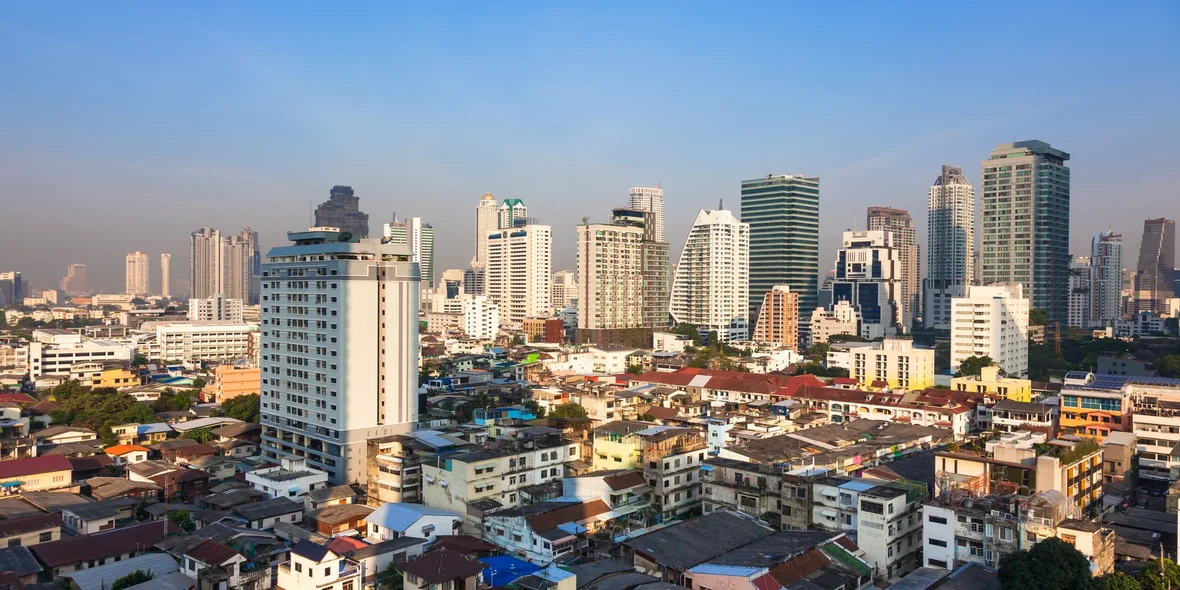
On the other hand, foreign demand remains strong, particularly in the condominium segment, and supports the most liquid locations, primarily Bangkok, Chonburi, and Phuket.
Foreign demand in Thailand is highly uneven. The majority of capital is concentrated in Bangkok, Chonburi, and Phuket, which together accounted for 83.1% of all foreign condominium transfers in 2025.
From the perspective of foreign buyers, the condominium segment leads by a wide margin. This is the primary format available for direct ownership within the 49% foreign quota per project. For example, in Phuket, 6,156 new condominiums were sold compared to 573 villas. Villas remain a strong premium segment, but in terms of transaction volume they lag behind apartments.
Domestic demand in Thailand shows a different pattern. In the low-rise segment, detached houses account for 62% of demand, while townhouses account for 38%.
Average property prices by type:
|
Property Type |
Average Price |
|
Urban house |
~$377,000 |
|
Suburban house |
~$141,000 |
|
Urban condominium |
~$209,000 |
|
Suburban condominium |
~$98,000 |
Urban houses in Thailand have moved into a significantly higher price range due to land costs. Condominiums remain a more accessible entry point than detached houses in central locations. As a result, apartments form the core unit of demand for both investors and foreign buyers.
Average price per square meter in key locations:
|
Location / Segment |
Average Price |
|
Bangkok, CBD, new condominiums |
~$7,580 / sq. m |
|
Bangkok, city fringe |
~$3,890 / sq. m |
|
Bangkok, suburban areas |
~$2,215 / sq. m |
|
Phuket, condominiums, market average |
~$4,295 / sq. m |
In Bangkok, the average price of new condominiums in the central business district exceeds $7,500 per sq. m, while in suburban areas it is around $2,200 per sq. m. In Phuket, the average level is approximately $4,300 per sq. m.
Phuket remains one of the most expensive locations in the country. The price range for villas can vary from around $180,000 to over $7.8 million, depending on the property type and location.
Hidden Costs When Buying Property in Thailand
In addition to taxes and registration fees, purchasing property in Thailand involves a number of additional costs that are not always obvious at the selection stage. These expenses are often underestimated, although together they can add another 2–5% to the transaction budget, and in some cases significantly more.
The sinking fund is a mandatory one-time contribution to the building’s capital repair reserve. It is charged when purchasing a condominium unit and is calculated based on the property’s area. The market average ranges from $10 to $30 per sq. m. For a 40 sq. m apartment, this equals approximately $400–$1,200.
The maintenance fee is a recurring payment for the upkeep of the complex, including security, swimming pool, infrastructure, and building management. The average cost is $1–3 per sq. m per month.
If legal services are used, a lawyer typically charges $500–$1,500 for due diligence and $1,000–$3,000 for full transaction support.
Foreign buyers almost always incur additional costs when transferring funds:
- Bank fees: about $50–$300
- Intermediary fees: up to about $500
- Exchange rate losses: 1–3% of the transaction amount
After the purchase, expenses do not end. Thailand applies an annual land and building tax calculated based on the cadastral value of the property:
|
Property Type / Use Case |
Tax Rate |
|
Condominium / house (primary residence) |
~0% – 0.10% |
|
Second home / investment property |
~0.02% – 0.30% |
If a property or land plot is classified as vacant or unused, the base rate starts at approximately 0.3%. If it remains unused for more than three consecutive years, the rate increases by 0.3 percentage points for each subsequent three-year period until it reaches a cap of 3%.
Frequently Asked Questions About Taxes and Costs
What is the main tax paid by the buyer when purchasing property in Thailand?
The primary mandatory payment is the transfer fee. The standard rate is 2% of the official appraised value of the property.
In addition, three other key charges are usually involved: stamp duty at 0.5%, Specific Business Tax at 3.3%, and withholding tax. Stamp duty and Specific Business Tax are not applied simultaneously. If SBT is charged, stamp duty does not apply.
Who typically pays stamp duty, Specific Business Tax, and withholding tax in Thailand?
Formally, these payments are usually assigned to the seller. In practice, the transfer fee is often split equally, while the seller’s taxes either remain their responsibility or are partially incorporated into the property price. Therefore, buyers should consider not only direct costs but also the full tax burden embedded in the transaction.
How is withholding tax calculated in Thailand?
If the seller is a company, withholding tax is typically 1% of the transaction price or the official appraised value, whichever is higher. If the seller is an individual, the calculation is more complex and depends on the holding period, appraised value, and a progressive tax scale. This is why, in the secondary market, this payment is often the most difficult to estimate in advance.
Can a foreigner own property in Thailand outright?
Foreigners can own condominium units freehold, provided the foreign ownership quota in the project is not exceeded. Under current rules, foreigners may own up to 49% of the total sellable area of a building. Direct ownership of land and houses by foreigners is heavily restricted, so leasehold structures or more complex legal arrangements are commonly used.
What types of properties do foreigners most often buy?
Foreign demand in Thailand is primarily concentrated in condominiums, with key demand locations being Bangkok, Chonburi, and Phuket.
Is a special document required to transfer funds?
For a foreigner purchasing a condominium freehold, it is usually necessary to confirm that the funds were transferred from abroad in foreign currency. This requires official bank documentation of the international transfer. Without such confirmation, property registration in the buyer’s name is typically not possible.
Is there an annual property tax in Thailand?
After purchase, owners pay an annual land and building tax. In typical residential scenarios, rates are often in the range of 0.02% to 0.10%, while vacant properties are taxed at higher rates that can increase over time up to 3%.
What most affects the total transaction cost in Thailand?
Key factors include the type of property, whether it is primary or secondary market, the seller’s status, the holding period, the official appraised value, and how costs are allocated in the contract.
Author

I write informative articles about real estate, investments, job opportunities, taxes, etc.