









Why Some Investors Are Nervous While Others See Opportunity


The Dubai real estate market in 2026 has reached a point where investor perception is increasingly diverging from actual market dynamics. After a record-breaking 2025, when monthly transaction volumes reached 15,000–17,000 deals, the market has entered a phase of correction.
In this interview, we speak with Alexey Dashkevich, Head of Kalinka Middle East, about what is really happening in the market: where panic ends and real opportunities begin, how deal structures are evolving, why the market is “cleansing” itself of opportunistic players, and which strategies are working today for investors with a 3–5 year horizon.
Preface
I genuinely like Dubai. This city has given me a lot — pace, opportunities, the right environment, personal growth, and a completely different scale of thinking. That’s exactly why it’s important for me to speak honestly about what is happening here right now, without unnecessary drama.
In recent weeks, Dubai has been heavily discussed in the media — from claims of empty streets to expectations that the real estate market is about to decline. But when you live here and work within the market every day, you see a very different picture.
Yes, a correction has begun. But this is not a story about weakness. On the contrary, it reflects the market’s maturity, the experience of the authorities, and the system’s ability to absorb pressure and adapt.
Situation in the City
— What is the current situation in Dubai? Is it true that the city is empty?
— No, the city is not empty.
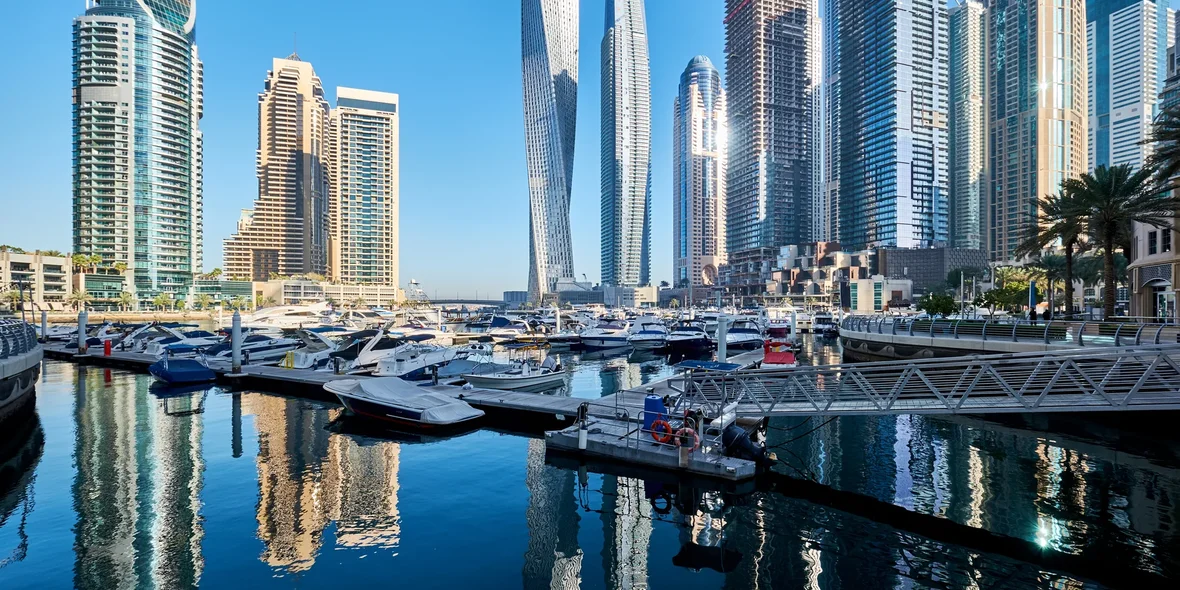
Yes, there are fewer tourists — that’s a fact. But the streets are not empty, restaurants are operating, Dubai Mall is busy, and crowds still gather around Burj Khalifa in the evenings. Many who temporarily left have already returned.
At the same time, there is still a background level of tension. People receive safety notifications on their phones, and every few days you can hear distant sounds. That exists.
But if you look at real life rather than headlines, the city is clearly not operating in crisis mode. Dubai continues to function in a calm and organized way.
To be honest, the main change expats notice is less traffic.
And that says a lot about Dubai: even in a challenging moment, it doesn’t fall apart — it adapts.
Competition in the Dubai Market
— What’s happening with real estate agents? Has competition decreased?
— Yes, and this is just the beginning.
In recent years, the market was largely driven by off-plan sales, where brokers earned 4–5% commissions from developers.
Now this model is changing.
Developers have reduced new launches, the market has become more cautious, and the focus is inevitably shifting toward the secondary market, where commissions are around 2% and must be shared with the agency. Broker incomes will inevitably decline by roughly 2–2.5 times. Many simply won’t be able to adapt, because the secondary market is significantly more complex.
Some brokers have already left. Others will follow.
But I don’t see this as a problem for the market. On the contrary, it’s a natural cleanup. The Dubai market had become overcrowded with people chasing quick money. Now, more of those who remain are professionals — those who can work with analytics, negotiations, and real seller motivation.
Sales Situation
— Which area of Dubai has seen the biggest drop in sales?
— None.
And this is an important point. It is incorrect to say that any specific area has declined more than others. What we are seeing is not a broad drop across districts, but selective repricing of individual properties.
In most cases, there are two main reasons.
The first is financial pressure on the seller. Multiple properties under payment plans, cash flow gaps in business, or an urgent need for liquidity.
The second is panic. If someone does not live in Dubai and follows the situation only through the news, it may seem like the right move is to exit the asset quickly.
That is the key difference between emotion and the actual market. News often looks far more dramatic than the real situation on the ground.
Distress Deals
— What are distress deals and why is everyone talking about them now?
— A distress deal is a property sold below market value when the seller needs to exit quickly.
There is bad distress, when weak properties in poor locations with low liquidity are being sold off. And there is what I would call “proper” distress, when sellers with real financial pressure are exiting quality assets in good or at least solid locations.
Sellers go below market price for several reasons: multiple properties under payment plans, cash flow gaps, panic driven by news, or simply the need for cash.
These are exactly the moments when opportunities appear that you would never see in a stable market.
Pricing of Distress Deals
— How far below market can you realistically buy today?
— Right now, you can buy better than six months ago. That’s a fact.
My team and I search for these opportunities across the entire market every day. We track transactions, speak directly with owners, and identify real seller motivation. The best options are shared by my assistant in our Telegram channel.
For example, a 38 sqm studio in JVC from developer IMAN was originally purchased at launch in 2024 for 693,000 AED. It is now being offered at 600,000 AED. The latest comparable transaction stands at 725,000 AED, with completion expected in 2027.
This means the entry today is around 323,000 AED upfront, followed by scheduled payments. The effective discount is about 17% below market.
Another case: a ready 1-bedroom apartment of 61 sqm in JVC by Binghatti is currently listed at 870,000 AED, while the latest transaction was at 980,000 AED. That’s roughly an 11% discount.
One of the most relevant examples is a 1-bedroom unit in Dubai Hills, a popular green community among Russian-speaking buyers. It is currently priced at 1.3 million AED, compared to a recent transaction at 1.5 million AED, a 13% gap.
Another example: an 81 sqm 1-bedroom apartment by Imtiaz in Dubai Islands, two minutes from the beach with partial sea views, was bought in 2025 for 1.9 million AED and is now offered at 1.7 million AED.
Ready units in Beach Walk 1 are trading around 2.4 million AED, with a gap of about 30% compared to the stabilized market, although this is a rare case.
A 114 sqm 2-bedroom apartment in Production City by Deyaar is now offered at 1.2 million AED. The original developer price was 1.43 million AED, and recent transactions are around 1.63 million AED. This represents a discount of about 26% below market.
This is not a “fire sale.” These are private sellers exiting at a loss. And for an investor who understands the market, this is exactly where opportunity begins.
Houses and Townhouses
— How much do houses and townhouses cost right now?
— It’s important to understand that in Dubai, properties with three bedrooms or more are usually townhouses or villas. Demand for them is high, while supply is noticeably more limited.
A townhouse is a home with a private entrance in a gated community, but with a shared wall with neighboring units.
In terms of pricing, ready 3-bedroom townhouses from Emaar in Arabian Ranches 3, around 180 sqm, are currently available at about 2.65 million AED, while the market average is closer to 3 million AED. That’s roughly an 11% discount.
For 4-bedroom units, around 230 sqm, two properties were sold at 3.1 and 3.3 million AED, compared to an average market level of about 3.9 million AED. The discount is around 15%.
An important detail is that a good distress unit in this segment can be sold within a single day. As mentioned, those two 4-bedroom townhouses were taken almost immediately.
Developer Pricing
— Why aren’t developers lowering prices?
— In my view, this clearly shows the maturity of the Dubai market.
Developers are not taking the approach of cutting prices aggressively just to sell quickly and exit. They are thinking long term, which is the right strategy.
Any strong developer has responsibility not only to new buyers but also to investors who have already purchased units in their projects. If prices were suddenly reduced, it would distort pricing benchmarks and negatively impact existing investors.
In Dubai, most transactions are publicly accessible, which makes the market highly transparent. Any sharp price reduction would immediately affect investor confidence, the developer’s reputation, and future sales.
That is why developers act more strategically. Instead of lowering prices, they adjust conditions by offering more flexible payment plans, covering certain fees, adding incentives, and temporarily slowing down new launches while selling existing inventory.
In other words, they are protecting the market in the long term. And in my opinion, this is the correct approach.
Transaction Volume
— What about transactions? Is the market declining?
— The numbers are there, but they need to be interpreted correctly.
In 2025, the Dubai real estate market was at its peak. In March alone, around 15,000 transactions were recorded, with consistently high activity throughout the year.
In 2026, February remained strong with around 17,000 transactions, but in March the number dropped to approximately 11,800.
Based on my internal data, February 2026 showed 11,418 primary market transactions and 5,609 secondary transactions, bringing the total to 17,027 deals.
In March, the primary market decreased to 8,959 transactions, while the secondary market recorded 2,869 deals, with a total of 11,828.
At first glance, it may seem like a sharp decline, but that is not entirely accurate. The data does not fully reflect reality because in the secondary market a deal is essentially an agreement between two parties.
In March, many buyers and sellers simply paused transactions, extended timelines, or delayed registration. The deals did not disappear. They were just shifted in time.
The primary market works differently. Buyers may have already signed and paid, but developers can register transactions with a delay of one to two months.
This means that part of March’s primary sales will only appear in official data in April or May.
So the current drop is not a real market decline but largely a timing effect. The market has not collapsed. It has simply become more cautious.
And that is exactly what has created a window of opportunity for buyers.
Bubble or Correction
— Is this a bubble? Are we seeing a correction now?
— Yes. This is exactly what a correction looks like.
Everyone was talking about a bubble. Here it is. But in reality, this is not a collapse. It is a normal market phase after a period of strong growth.
Events in the Middle East acted as a catalyst.
For investors who entered with a short-term strategy of buying and reselling within one or two years, this is not the best moment to exit.
But for those who understand how real estate works, the horizon has always been three to five years. Within that timeframe, the current correction is not a problem. It is an opportunity.
Mortgage Situation
— What is happening with mortgages?
— This is where one of the most interesting opportunities in the market is right now.
Rates currently start from 3.75%, with an average term of up to 25 years. The minimum down payment is 20%. Mortgages can be obtained even during construction, once the project reaches 50% completion.
The most important point is that a mortgage can be taken for the final payment at handover. Many of my clients use this structure.
Here is how it works. You pay for the property through a payment plan, and by the time of handover, around 40% of the price usually remains outstanding. In some cases, it can be up to 65%. This remaining portion can be covered with a mortgage.
This approach is efficient because it avoids the need to commit the full amount of personal funds.
Then the strategy begins. After handover, you can refinance the property and release cash, up to 50% of its current market value, and use these funds for other purposes.
At the same time, the property can be used as a base for scaling. Up to 80% of its value can be leveraged to acquire another property in Dubai.
The key point is that in many cases today, mortgage payments are 20–30% lower than rental costs.
For example, you enter a deal with a 20% down payment, then rent out the property. The tenant effectively covers the mortgage payments, meaning the asset begins to pay for itself.
The main question is: in which other market today can you enter with 20% and build a model where the property largely services itself?
Outlook
— Why do you remain positive about the city overall?
— Because I have seen how this city handles difficult periods.
Dubai has already faced serious challenges, and the COVID period is a clear example. The authorities responded quickly, the market adapted, and the city not only held its ground but ultimately emerged stronger.
That is why I trust this system. Here, a crisis is not treated as a trigger for chaos. It is treated as a management task that needs to be addressed quickly, calmly, and with a long-term perspective.
And I believe this is one of the reasons why Dubai continues to attract people, capital, and business even during periods of global uncertainty.
What Should Buyers Do Now? Buy or Wait?
Let’s be direct and realistic: buying off-plan from developers is not the right move right now. In most cases, these properties are already overpriced. The growth has already happened, and the upside is limited. You are entering at a price where future profit is already priced in, leaving little room for your own gain.
Buying resell units during construction, when a previous investor exits, can make sense, but only selectively. This is the segment where money is being made right now. However, not every discount automatically makes a deal attractive.
If it is a liquid property and the seller is exiting below their purchase price due to real financial pressure, it is worth considering. But if it is a weak project that has simply struggled to sell, then it should be avoided. The focus should be only on quality distress opportunities.
Buying ready properties in strong locations at 2022–2023 price levels is a clear yes. This is the strongest strategy at the moment. The challenge is that such opportunities are extremely limited. The best deals either never reach the open market or are sold within one or two days.
In summary, this is not the time to buy just anything. But properties priced below market, in strong locations, with genuine seller motivation are absolutely worth attention. Everything else is simply entering the market without an edge, and in the current phase, that is already a mistake.
Conclusion
I still strongly believe in this city.
Dubai has repeatedly shown that it can move through difficult periods in a calm, fast, and strategic way. That is why I see the current situation not as a problem, but as a natural stage in the market’s evolution.
The Dubai market is not falling. It is resetting and becoming more mature and rational.
Weaker players are leaving.
Stronger ones are entering.
Panic is already here. Which means opportunities are already here as well.
Those who are buying now with clarity and discipline will thank themselves in a few years.
Those who act based only on fear usually miss the moment.